
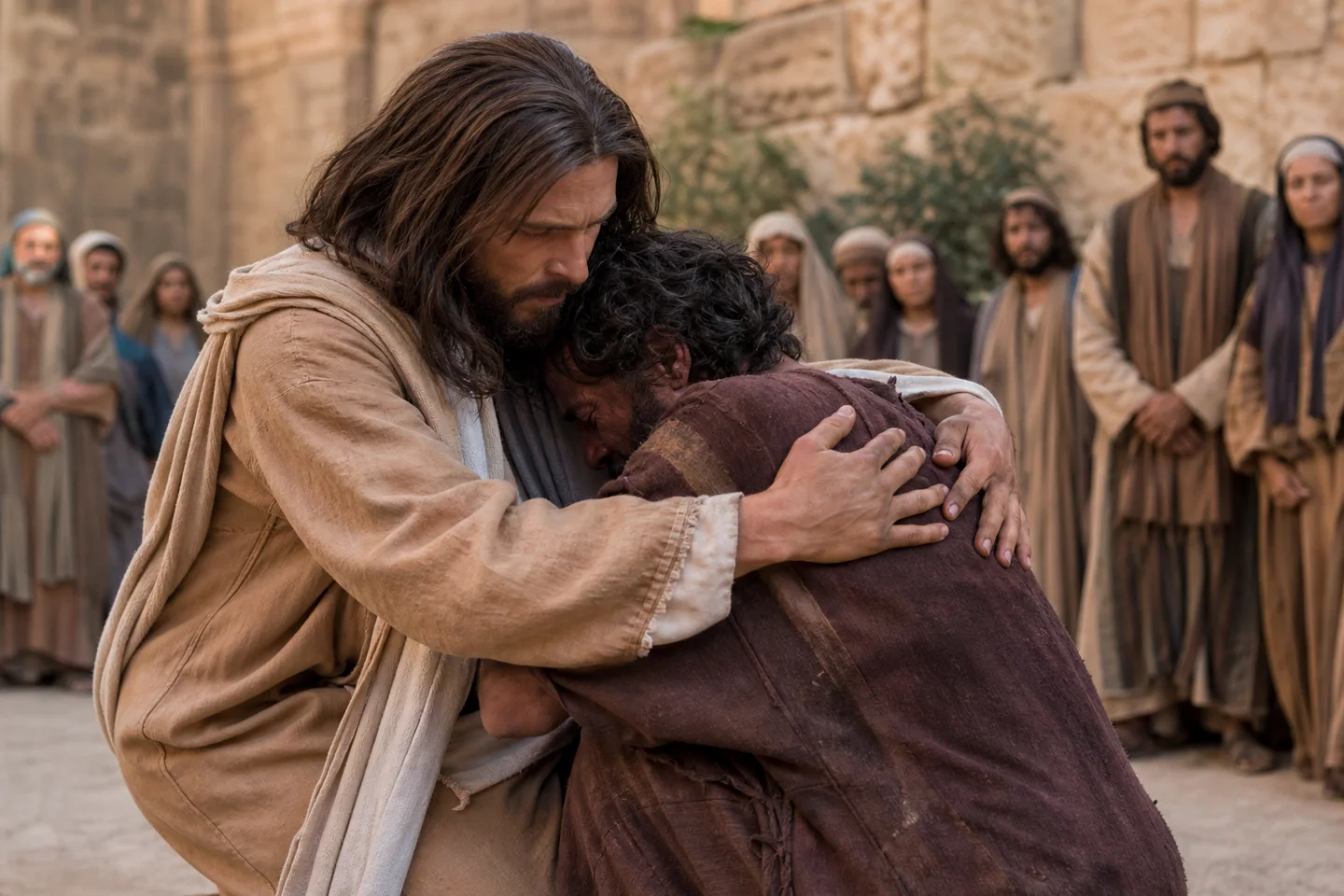
Forgiveness becomes difficult when it concerns an actual offense rather than a general ideal. Peter's question acknowledges that difficulty: how often should he forgive a brother who sins against him? Jesus answers with a number and then a story. Ephesians adds a different perspective, describing the attitudes to put away and the kindness to practice instead. Reading Matthew 18:21–35 with Ephesians 4:31–32 keeps forgiveness connected to behavior. The question is not merely whether someone can say the right words. It is whether mercy received changes the way another person's debt is held, and whether the desire to injure them continues to govern the relationship.
The servant receives more than he requests
Jesus compares the Kingdom of Heaven to a king settling accounts with his servants. One owes ten thousand talents and cannot pay. The king orders the sale of the man, his family, and his possessions. The servant falls down and pleads for patience, promising repayment.
The king's response is not simply an extension of the deadline. Moved with compassion, he releases the servant and forgives the debt. That distinction drives the story: the man asks for time and receives cancellation. His new position depends on a generosity that his own resources could not provide.
The scale of the contrast is clear without converting ancient money into a modern salary or currency. The passage supplies what the reader needs: a great debt, inability to pay, a plea, and compassion. Speculative calculations would add apparent precision without being necessary to understand what changes for the servant.
Matthew 18:21–35
The second encounter exposes the first servant
After leaving, the forgiven man finds a fellow servant who owes him one hundred denarii. He seizes him by the throat and demands payment. His companion falls down and asks for patience, echoing the kind of plea the first servant has just made himself.
The request is refused. The fellow servant is sent to prison until the debt is paid. Other servants see what happens, are deeply distressed, and report it to their lord. The story makes the contradiction public: the man who has benefited from compassion will not respond compassionately to a need placed before him.
The smaller debt is still a debt within the parable. Jesus does not have to pretend that nothing is owed in order to expose the cruelty of the response. The contrast concerns what the first servant does with the mercy he received. He enjoys release for himself while using another person's obligation as a reason to dominate him.
Matthew 18:21–35
Peter's number is not a new resentment ledger
Before the parable, Peter asks whether seven acts of forgiveness are enough. In the World English Bible supplied here, Jesus responds with seventy times seven. The story that follows explains the answer through the relation between the lord and the two servants.
In that context, the number should not be treated as a more elaborate tally after which mercy may be withdrawn. This is an interpretation of the passage's movement, rather than a separate arithmetic rule. The narrative takes attention away from counting and toward a heart that can accept compassion while refusing to share it.
The initial question also matters because it assumes a real offense. Forgiveness is not needed because harm is imaginary. The parable preserves responsibility by showing accounts, debts, and consequences. Mercy has meaning within that reality, not because the reality has been erased.
Matthew 18:21–35
The ending is serious
> Shouldn’t you also have had mercy on your fellow servant, even as I had mercy on you?’
Matthew 18:33 — World English Bible
The lord angrily hands the servant over to the tormentors until the debt is repaid. Jesus concludes by warning about refusing to forgive a brother from the heart. The ending does not allow the reader to admire mercy as an attractive idea while leaving a deliberate refusal of mercy untouched.
At the same time, the story does not begin with the servant purchasing his lord's compassion through good conduct. Compassion is given first. The later warning exposes the incompatibility between receiving that gift and maintaining a merciless posture toward another person. Reading the order carefully avoids turning the parable into a simple fee-for-forgiveness arrangement.
Forgiving from the heart reaches beyond a spoken formula. The servant's failure is visible in his actions: he refuses the plea and imposes imprisonment. The passage does not provide a psychological timetable in which painful feelings must vanish instantly. Remembering an injury and choosing to keep punishing someone are not identical things, and the story directly confronts the latter.
Matthew 18:21–35
Ephesians describes a different way to treat one another
Ephesians 4:31 names bitterness, wrath, anger, outcry, slander, and malice as things to put away. Verse 32 then describes what should take their place. Kindness, tenderheartedness, and forgiveness belong together, with God's forgiveness in Christ given as the reference point.
> And be kind to one another, tender hearted, forgiving each other, just as God also in Christ forgave you.
Ephesians 4:32 — World English Bible
Forgiveness here is not a solitary sentence spoken over an otherwise unchanged pattern of contempt. It is linked with a different disposition toward people. This gives the reader something concrete to examine: whether words and actions are being shaped by kindness or by an ongoing desire to wound.
A practical application may begin with naming the offense truthfully rather than minimizing it. Another step is to recognize one's own need for mercy. Then the question becomes how resentment is being expressed: through humiliation, repeated attacks, or an insistence that the other person can never be released from the role of debtor. These are applications of the passages, not a mandatory sequence supplied word for word by them.
Ephesians 4:31–32 · Matthew 18:21–35
Mercy does not require calling harm good
Neither selection says that forgiveness makes an offense acceptable or that every damaged relationship must immediately return to its previous form. Matthew depicts a real debt; Ephesians rejects malice. The passages do not offer a complete procedure for every situation involving danger or abuse.
As a pastoral safeguard, forgiveness should not be used to pressure someone into silence about harm or into renewed exposure to an unsafe situation. That distinction is an application rather than an additional biblical quotation. It prevents a command about mercy from being turned into permission for continuing damage.
Ephesians can instead prompt a more honest question about the present: what would it mean to remove malice from the way I speak and act, while still telling the truth? The aim is not to manufacture a pleasant appearance. It is to let kindness become real without requiring a denial of what has happened.
Matthew 18:21–35 · Ephesians 4:31–32
Conclusion
The forgiven servant's tragedy is not that he misunderstands the size of a number. It is that compassion stops with him. Matthew and Ephesians bring the reader back to the same demanding possibility: mercy can be received as a gift and then become visible in the treatment of another person.
Biblical references
- Matthew 18:21–35
- Ephesians 4:31–32