The Ark of the Covenant is one of the Bible’s most recognized sacred objects, but popular images can easily obscure what the biblical texts actually say. Scripture presents it as a carefully made chest for Israel’s worship—not a magical charm or an independent source of power. Its construction, location, transport, and use were all governed by specific instructions. The ark’s story stretches from Israel’s wilderness worship to the temple in Jerusalem, while its final historical fate is not directly explained in the Bible.
Short answer: What was the Ark of the Covenant?
The Ark of the Covenant was a sacred chest made at God’s command for the sanctuary of Israel. It was constructed of acacia wood, overlaid with gold, and designed to hold the tablets of the testimony—the covenant tablets given to Israel. Its gold cover, called the mercy seat, included two cherubim and was identified as the place where God would meet with Moses and communicate with him.
The ark belonged in the Most Holy Place, the innermost room of the tabernacle and, later, Solomon’s temple. In this setting it marked the seriousness of God’s holiness and Israel’s covenant relationship with him. The biblical narrative also makes clear that it was not an object Israel could use to guarantee success. When Israel brought it into battle against the Philistines expecting deliverance, Israel was defeated and the ark was captured.
Exodus 25:10–22 · Deuteronomy 10:1–5 · Exodus 40:20–21 · 1 Samuel 4:3–11
What did the ark look like?
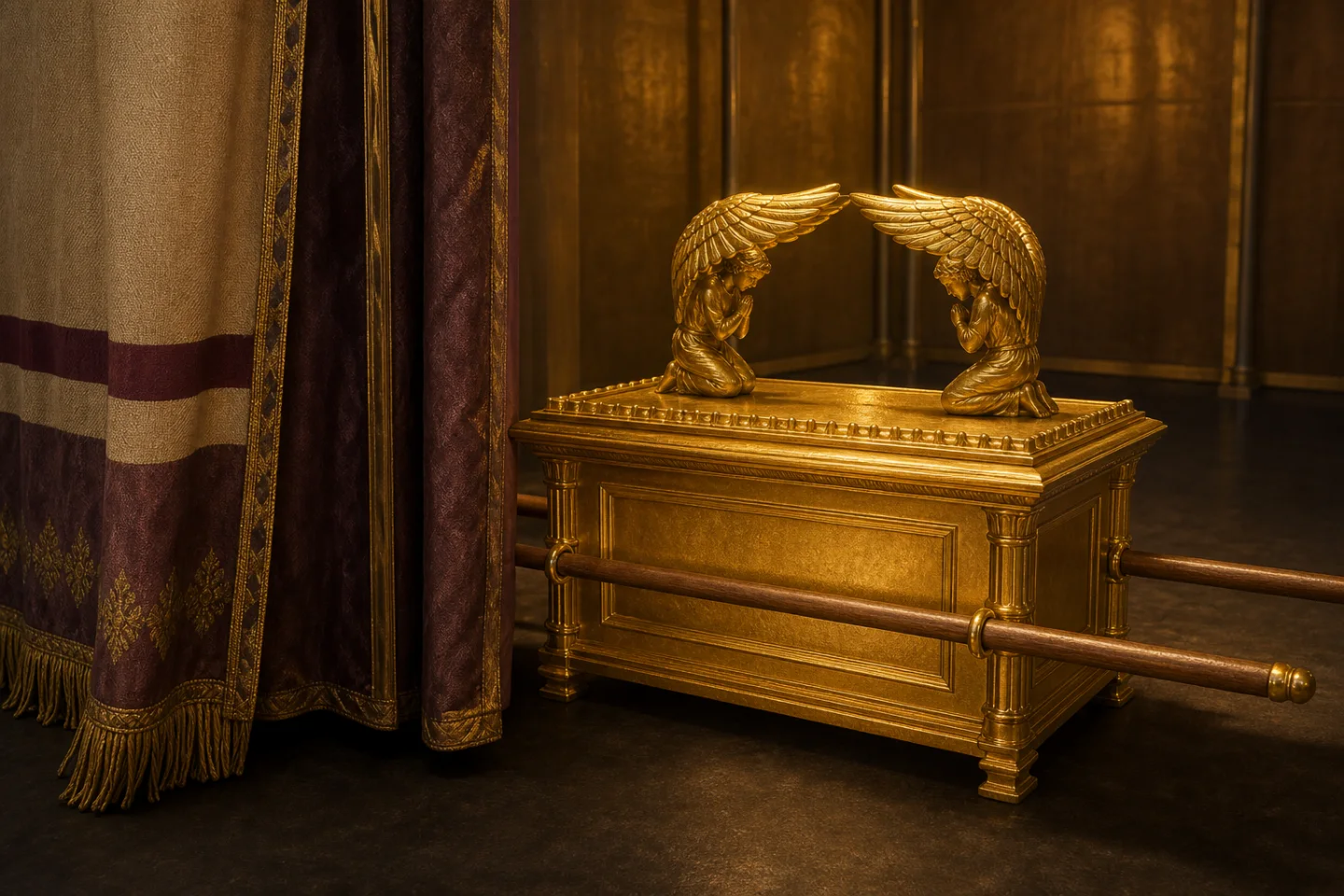
Exodus gives a detailed description of the ark’s construction. It was a rectangular chest of acacia wood, measuring two and a half cubits long, one and a half cubits wide, and one and a half cubits high. It was overlaid with pure gold inside and out and finished with a gold molding around it.
Four gold rings were attached to the ark, two on each side. Poles made of acacia wood and overlaid with gold passed through these rings so the ark could be carried without being handled directly. The poles were to remain in the rings.
The ark itself should be distinguished from its cover. The cover was the mercy seat, made of gold, with two cherubim at its ends. Their wings stretched upward over the mercy seat, facing one another. Biblical descriptions provide the essential features, but they do not authorize every artistic reconstruction or later popular detail often associated with the ark.
Exodus 25:10–22 · Exodus 37:1–9 · Numbers 4:4–6
What was inside the Ark of the Covenant?
The clearest and most consistent answer in the Torah and Kings is that the ark held the stone tablets of the covenant. Deuteronomy recounts Moses placing the tablets in the ark, and Exodus says that he put the testimony in it. At the dedication of Solomon’s temple, 1 Kings specifically states that there was nothing in the ark except the two stone tablets Moses had placed there at Horeb.
Hebrews 9:4 refers to the ark in connection with a golden jar containing manna, Aaron’s rod that budded, and the tablets of the covenant. This passage should be read carefully alongside 1 Kings 8:9. Hebrews associates these items with the ark and the sanctuary setting, while 1 Kings records that, at the temple dedication, the two tablets were in the ark. The texts should not be forced into a detailed harmonization beyond what they explicitly state.
Deuteronomy 10:1–5 · Exodus 40:20 · 1 Kings 8:6–9 · Hebrews 9:1–5
Where was the ark kept, and what was its purpose?
The ark stood behind the veil in the Most Holy Place. In the tabernacle, the veil separated this inner space from the Holy Place, and the ark was placed within it. When Solomon built the temple in Jerusalem, the ark was brought into the temple’s inner sanctuary, also called the Most Holy Place.
Its mercy seat was associated with God’s appointed meeting and communication with Moses. The ark also stood at the center of the Day of Atonement instructions. On that annual day, the high priest entered the inner sanctuary according to the sacrificial requirements of Leviticus 16, including the prescribed use of blood before the mercy seat.
Taken together, these passages support a broader interpretation: the ark visibly signaled God’s covenant with Israel, his holiness, and the regulated access to his presence. This is a synthesis of the biblical material rather than a single verse’s definition, but it follows naturally from the tablets it held, its placement behind the veil, and the restrictions surrounding it.
Exodus 25:21–22 · Exodus 26:31–34 · Leviticus 16:2, 11–17 · Numbers 7:89 · Hebrews 9:3–7
Who could carry the ark, and why could it not be touched?
The ark was made to be carried with its poles, not by direct contact. Numbers warns that the holy things were not to be touched, and the Levites had a defined responsibility in their transport. Later, when David arranged to bring the ark to Jerusalem, Chronicles emphasizes that the Levites were to carry it with the poles, in keeping with the instruction given through Moses.
The death of Uzzah during an earlier attempt to move the ark is recorded in 2 Samuel 6. The account should not be treated as a sensational story or detached from its context. David later recognized that the ark had not been moved according to the prescribed order, and the subsequent transfer was carried out by Levites using the poles. The episode underscores the importance the narrative places on obeying God’s instructions concerning holy things.
Exodus 25:12–15 · Numbers 4:15 · 2 Samuel 6:1–19 · 1 Chronicles 15:2, 13–15
The ark in Israel’s history: a brief timeline
The ark appears at several decisive moments in Israel’s story:
• **At Sinai and in the wilderness:** It was made for the tabernacle and received the tablets of the testimony.
• **At the Jordan River:** Priests carrying the ark led Israel as the people crossed into the land.
• **At Jericho:** The ark was carried in the procession around the city before its walls fell.
• **In conflict with the Philistines:** Israel brought the ark into battle, believing it would save them from their enemies. Instead, Israel was defeated and the Philistines captured it. The Philistines later returned it after suffering severe judgments in their cities.
• **At Kiriath-jearim and Jerusalem:** The ark remained at Kiriath-jearim for a time. David eventually brought it to Jerusalem.
• **In Solomon’s temple:** Solomon placed it in the Most Holy Place during the temple dedication.
This history shows that the ark was important in Israel’s worship and national life, but it did not guarantee victory simply because it was present. The defeat in 1 Samuel 4 directly challenges any attempt to treat it as a religious talisman.
Exodus 25:10–22 · Exodus 40:20–21 · Joshua 3:1–17 · Joshua 6:1–20 · 1 Samuel 4:1–11 · 1 Samuel 5:1–12 · 1 Samuel 6:1–19 · 1 Samuel 7:1–2 · 2 Samuel 6:1–19 · 1 Kings 8:1–11
What happened to the Ark of the Covenant?
The Bible does not give a direct account of the ark’s final fate. It is mentioned in the time of King Josiah, when Levites are instructed to put the holy ark in the house Solomon built. Jeremiah later speaks of a future time when people will no longer speak of, remember, miss, or make another ark of the covenant. Neither text explains where the historical ark went afterward.
Many proposed locations and stories about the ark circulate today. Some belong to later religious traditions, local claims, or modern speculation. They should not be presented as established biblical facts. From the biblical record alone, the ark’s final historical whereabouts remain unknown.
2 Chronicles 35:3 · Jeremiah 3:16
The ark in Hebrews and Revelation
The New Testament refers to the ark in two notable contexts. Hebrews 9 describes features of the tabernacle and uses the sanctuary system to explain Christ’s priestly work and access to God. The ark is part of that larger argument; it is not merely an object of historical curiosity.
Revelation 11:19 describes the ark of God’s covenant appearing in a heavenly vision. Because the passage occurs within a vision, it should not automatically be identified with the missing historical ark or used as evidence for a modern physical location. Its meaning belongs to Revelation’s symbolic and worship-filled portrayal of God’s reign and covenant faithfulness.
Hebrews 9:1–14 · Revelation 11:19
Conclusion
The Ark of the Covenant was Israel’s sacred covenant chest: a gold-covered acacia-wood ark that held the covenant tablets and stood beneath the mercy seat in the Most Holy Place. Its design, restricted handling, and role in the Day of Atonement highlight the holiness of God and the ordered approach to him. It accompanied Israel through major events and was eventually placed in Solomon’s temple. Although later biblical texts still refer to it, Scripture does not reveal its final historical location.
Biblical references
- Exodus 25:10–22
- Exodus 26:31–34
- Exodus 37:1–9
- Exodus 40:20–21
- Leviticus 16:2
- Leviticus 16:11–17
- Numbers 4:15
- Numbers 7:89
- Deuteronomy 10:1–5
- Joshua 3:1–17
- Joshua 6:1–20
- 1 Samuel 4:1–11
- 1 Samuel 5:1–12
- 1 Samuel 6:1–19
- 1 Samuel 7:1–2
- 2 Samuel 6:1–19
- 1 Chronicles 15:2
- 1 Chronicles 15:13–15
- 1 Kings 8:1–11
- 2 Chronicles 35:3
- Jeremiah 3:16
- Hebrews 9:1–14
- Revelation 11:19