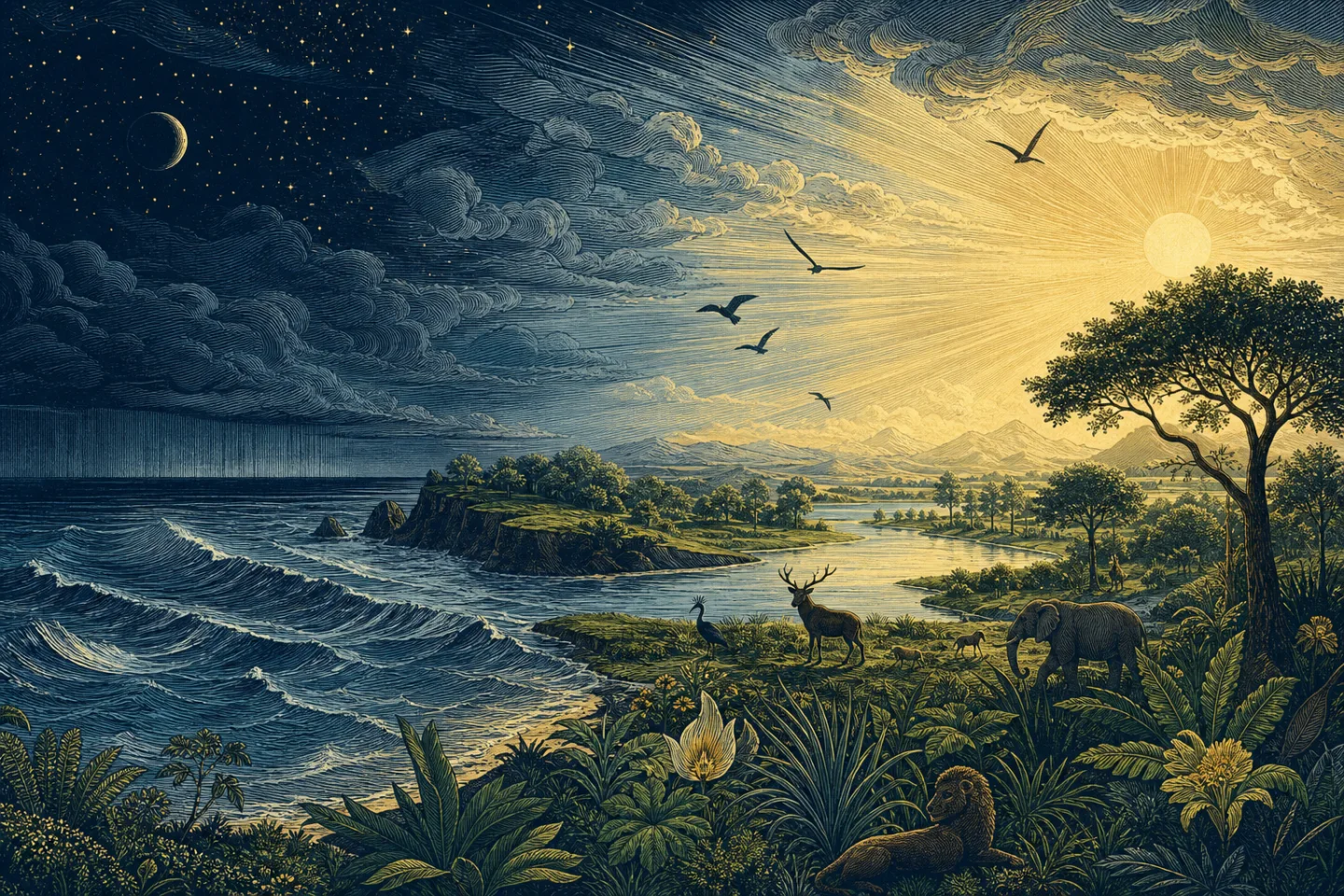
Genesis opens with God creating the heavens and the earth and ordering a world able to sustain life. The movement through light, spaces, land, living creatures, and humankind establishes the biblical frame of creation before the focus narrows to the garden and human vocation.
Creation Begins with God
The first sentence of Genesis establishes the central subject of the account: God. The heavens and the earth do not appear as independent realities or as products of rival divine powers. Genesis presents them as God’s creation (Genesis 1:1).
The opening scene then describes the earth as “formless and empty,” with darkness over the deep and God’s Spirit hovering over the waters (Genesis 1:2). The wording portrays a world not yet arranged as the inhabited realm that follows. It is the setting from which God begins to bring distinction, fruitfulness, life, and purpose.
The world is neither divine nor outside God’s concern; it belongs to the Creator. Later biblical texts echo this conviction by celebrating God’s power in creation and his rule over what he has made (Psalm 33:6–9; Isaiah 40:26–28).
Genesis next records God’s first spoken command—“Let there be light”—which begins the sequence of separations and provisions across the days (Genesis 1:3).
Genesis 1:1–2 · Psalm 33:6–9 · Isaiah 40:26–28 · Genesis 1:3
From an Unordered Earth to a World Full of Life
Genesis 1 unfolds across six days, followed by a seventh day (Genesis 1:3–2:3). Its sequence carries the scene from an earth described as unformed and unfilled to a world differentiated, inhabited, and supplied for life.
On the first day, God brings forth light and separates it from darkness (Genesis 1:3–5). On the second, he separates the waters and makes the expanse, or sky (Genesis 1:6–8). On the third, dry land appears, the waters are gathered, and the earth produces vegetation (Genesis 1:9–13). Day and night, sky and waters, land and plant life establish the realms in which life will live.
The following days correspond to those realms by populating and ordering them. On the fourth day, lights in the expanse mark times and seasons and give light on the earth (Genesis 1:14–19). The fifth brings creatures of the waters and birds of the sky (Genesis 1:20–23). The sixth includes land animals and, finally, humankind (Genesis 1:24–31). What began with darkness, waters, and an uninhabited earth becomes a world with rhythms, food, creatures, and a human vocation.
At each stage, the movement is introduced by God’s speech. That repeated verbal pattern comes to the foreground in the account’s statements that what God commands happens and that he judges his work good.
Genesis 1:2–25 · Genesis 1:3–5 · Genesis 1:6–13 · Genesis 1:14–25
God Creates by His Word and Declares His Work Good
A repeated pattern gives Genesis 1 much of its rhythm: God speaks, what he commands comes to be, and God sees that it is good. The first example appears when God says, “Let there be light,” and there is light (Genesis 1:3). The pattern recurs as the account advances.
God speaks, commands, names, blesses, and evaluates. His word accomplishes what it declares, and the repeated verdict of goodness identifies the created world as the fitting work of its Maker. Genesis records this assessment after major stages of the account, including light, land and seas, vegetation, the lights in the sky, sea creatures, and land animals (Genesis 1:4, 10, 12, 18, 21, 25).
After humanity is created, the account reaches its fullest evaluation: God sees everything he has made, and it is “very good” (Genesis 1:31). This is Genesis 1’s final judgment on the completed creation.
Psalm 104 develops a similar response, praising the wisdom displayed in God’s many works and the life sustained through his provision (Psalm 104:24–31).
Genesis 1:3–4 · Genesis 1:9–10 · Genesis 1:21 · Genesis 1:31 · Psalm 104:24–31
Humanity: God’s Image, Male and Female
The creation of human beings is the climax of the sixth day. God says that humanity is to be made in his image and likeness, and Genesis immediately identifies this humanity as male and female: “God created man in his own image. In God’s image he created him; male and female he created them” (Genesis 1:27).
Genesis does not reduce God’s image to a single human capacity. It explicitly presents the image as belonging to humanity as male and female. The passage therefore gives both man and woman a shared identity before God.
Christians commonly understand this identity as the basis for distinctive human dignity. Psalm 8 likewise marvels at the significant place God gives human beings amid the works of his hands (Psalm 8:3–9).
Genesis 1:26–28 · Genesis 1:27 · Psalm 8:3–9
Fill, Rule, and Care: Humanity’s Commission Within Creation
Genesis 1 joins humanity’s creation to a task. God blesses the man and the woman and commands them to be fruitful, multiply, fill the earth, and exercise rule over the living creatures (Genesis 1:28). He also provides seed-bearing plants and fruit-bearing trees for human food, while giving green plants to animals (Genesis 1:29–30). Human life, animal life, and food are presented as gifts within God’s ordered world.
Genesis 2 gives the commission a garden setting. God places the man in Eden “to cultivate and keep it” (Genesis 2:15). The mandate to rule and the task of cultivating and keeping together portray human beings as responsible agents under the Creator.
The account’s sixth-day material ends with God’s comprehensive verdict that all he has made is “very good” (Genesis 1:31). Genesis 2:1 then shifts from human blessing and provision to the completion of the heavens and earth and the distinctive blessing of the seventh day (Genesis 2:1–3).
Genesis 1:28–30 · Genesis 2:15 · Psalm 8:6–8 · Genesis 1:31 · Genesis 2:1–3
The Seventh Day Completes the Account
Genesis 2:1–3 is not an afterthought to the creation story. It completes it. Once the heavens, earth, and their inhabitants are finished, God ceases from his work on the seventh day. The text says that God blessed the seventh day and made it holy because he rested from his work of creation (Genesis 2:1–3).
God’s rest should not be understood as exhaustion. Genesis does not suggest that the Creator lacked strength. Rather, the rest marks the completion of his creative work. The seventh day is distinguished by God’s cessation, blessing, and sanctification.
This pattern later becomes significant for Israel’s Sabbath. Exodus 20 grounds the command to remember the Sabbath in God’s six days of making heaven and earth and his rest on the seventh day (Exodus 20:8–11). Exodus 31 also presents the Sabbath as a sign linked to the Creator’s pattern of work and rest (Exodus 31:12–17).
After this seventh-day conclusion, Genesis 2:4 resumes the story at the point of “the heavens and the earth,” narrowing the narrative from the completed whole to the ground, the garden, and the humans within it.
Genesis 2:1–3 · Exodus 20:8–11 · Exodus 31:12–17 · Genesis 2:4
How Genesis 2 Expands the Creation Story
After the conclusion of the seventh day, Genesis 2:4–25 returns to the creation setting with a concentrated focus on human life. It tells of the formation of the man, the planting of the garden, the man’s work, the animals brought before him, and the formation of the woman.
Genesis 1 provides the broad sweep of the world’s creation and humanity’s place within it. Genesis 2 narrows the scene, developing humanity’s relation to God, the ground, work, the animals, and the woman.
God plants the garden and places the man there (Genesis 2:8, 15). The chapter also presents human life as relational: the man is not meant to remain alone, and the woman is formed as the corresponding partner described at the chapter’s close (Genesis 2:18–25).
Genesis 2’s garden, animals, and human pair give a particular setting to the creation account. The biblical texts that follow move outward again, from this garden scene to the heavens, the living world, and the Creator’s continuing relation to all things.
Genesis 2:4–9 · Genesis 2:15–25
Creation in the Rest of the Bible
The rest of Scripture returns to creation as a ground for worship and trust. Psalm 19 says that the heavens declare God’s glory, while Psalm 104 celebrates the wisdom, variety, and ongoing provision evident in the living world (Psalm 19:1–6; Psalm 104:24–30). Isaiah directs attention to the Creator who calls the stars by name and does not grow faint or weary (Isaiah 40:26–28).
The New Testament likewise speaks of creation’s dependence on God. Paul tells the Athenians that the God who made the world gives life to all (Acts 17:24–26). Colossians declares that all things were created through and for Christ and hold together in him (Colossians 1:15–17). Revelation depicts heavenly worship offered to God because all things exist by his will (Revelation 4:11).
These texts receive and extend Genesis’s confession that the world has its origin in God, belongs to him, and points to its Maker.
Psalm 19:1–6 · Psalm 104:24–30 · Isaiah 40:26–28 · Acts 17:24–26 · Colossians 1:15–17 · Revelation 4:11
Conclusion
The seventh day completes the account: God ceases from his creative work, blesses the day, and makes it holy. The world is therefore presented as a completed work with a rhythm and purpose that precede every human use of it.
Biblical references
- Genesis 1:1–31
- Genesis 2:1–25
- Exodus 20:8–11
- Exodus 31:12–17
- Psalms 8:3–9
- Psalms 19:1–6
- Psalms 33:6–9
- Psalms 104:1–35
- Isaiah 40:26–28
- John 1:1–3
- Acts 17:24–26
- Romans 1:20
- Colossians 1:15–17
- Revelation 4:11