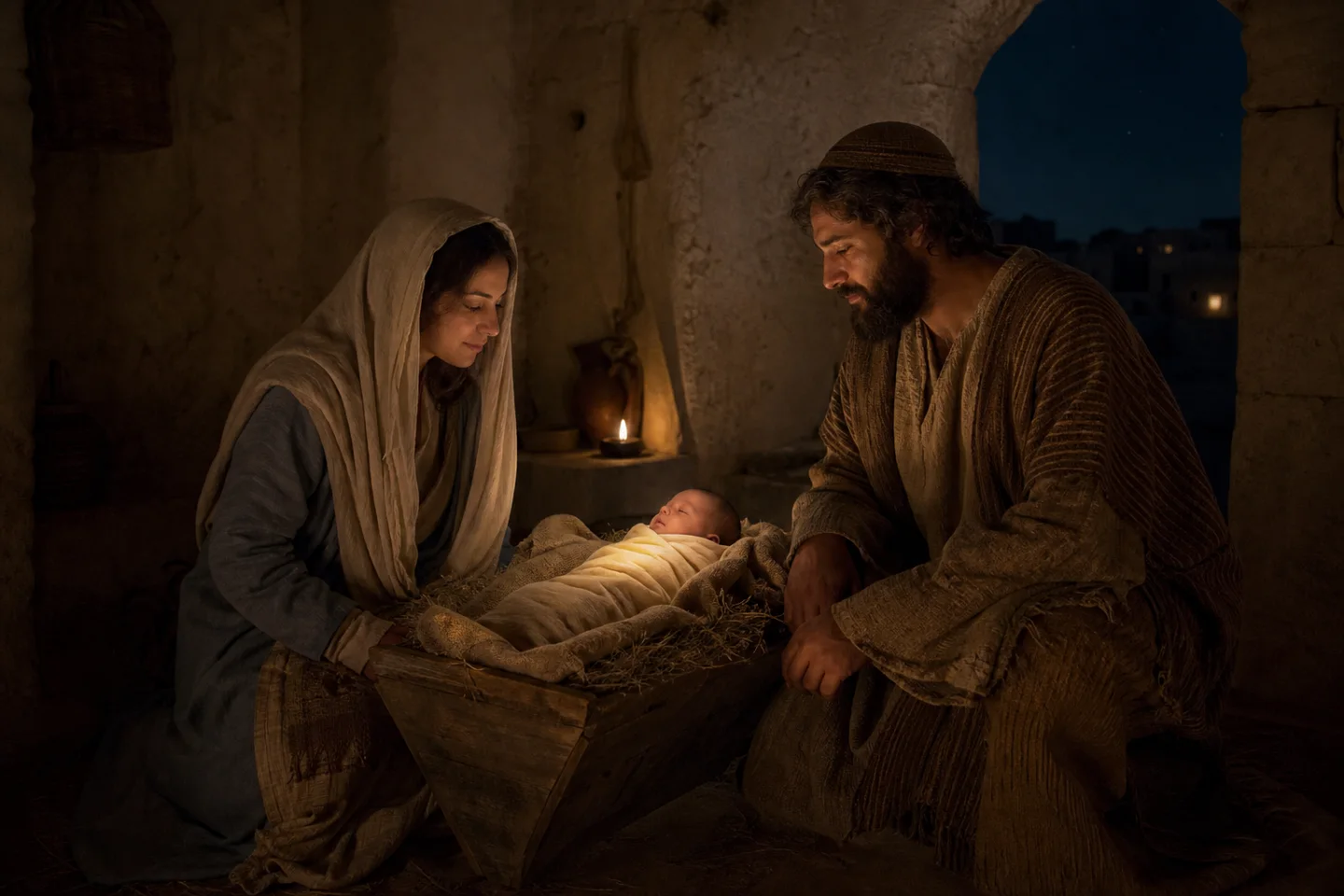
Matthew begins beside Joseph, while Luke travels from Nazareth to Bethlehem and the shepherds. Their distinct scenes agree in identifying the child, locating his birth within Israel’s story, and showing the first human responses to his arrival.
The Biblical Account in Brief
Matthew begins before Jesus’ birth, when Mary is engaged to Joseph. Before they live together, she is found to be pregnant through the Holy Spirit. Joseph, described as righteous, plans a quiet separation rather than public disgrace. In a dream, however, an angel tells him not to fear taking Mary as his wife and instructs him to name the child Jesus. Joseph obeys.
Luke tells the Bethlehem setting. During an enrollment associated with a decree from Caesar Augustus, Joseph travels from Nazareth in Galilee to Bethlehem in Judea, David’s city. Mary accompanies him, and while they are there she gives birth to her firstborn son. She wraps him in cloths and lays him in a manger because there is no place for them in the lodging. Nearby shepherds receive an angelic announcement that a Savior, Christ the Lord, has been born in the city of David. They go to see the child with Mary and Joseph, then return glorifying God.
Thus the shared core is clear: Jesus is born to Mary, Joseph receives and names him, and the birth occurs in Bethlehem. Matthew’s immediate birth narrative follows Joseph and explains the meaning of Jesus’ birth, while Luke supplies the journey, manger, angels, and shepherds.
Matthew 1:18–25 · Luke 2:1–20
Before Bethlehem: Mary, Joseph, and the Promise Received
The story’s first disclosed response is Mary’s. Luke records the angel Gabriel’s announcement to her in Nazareth: she will bear a son, Jesus, who will receive Davidic royal language. He will reign over the house of Jacob, and his kingdom will have no end. When Mary asks how this can happen since she is a virgin, the answer points to the Holy Spirit and God’s power (Luke 1:26–38).
Matthew approaches these events through Joseph’s dilemma. Mary and Joseph are engaged, but before they come together Mary is found pregnant by the Holy Spirit. Joseph intends to end the relationship discreetly. Then an angel appears in a dream: “Joseph, son of David, don’t be afraid to take to yourself Mary as your wife, for that which is conceived in her is of the Holy Spirit” (Matthew 1:20, WEB). The angel also tells Joseph to name the child Jesus, because he will save his people from their sins.
Matthew explicitly connects these events with Isaiah’s prophecy concerning Emmanuel. The Gospel explains the name as “God with us” (Matthew 1:22–23; Isaiah 7:14). Joseph responds in obedience: he takes Mary as his wife and gives the child the name Jesus. The account does not present Joseph as Jesus’ biological father; it presents him as the obedient husband of Mary and as one identified with David’s line.
Luke 1:26–38 · Matthew 1:18–25 · Isaiah 7:14
From Nazareth to Bethlehem: the Birth and the Manger in Luke
Joseph’s obedience leads into Luke’s account of the birth itself. Luke places it within a public setting: a decree of Caesar Augustus for an enrollment. Joseph travels from Nazareth to Bethlehem because he belongs to the house and family of David. Mary, who is engaged to him and expecting a child, goes with him (Luke 2:1–5).
While they are in Bethlehem, Mary gives birth. Luke’s description is spare but memorable: she wraps her son in cloths and lays him in a manger, “because there was no room for them in the inn” (Luke 2:7, WEB). Some translations render the final word as “lodging” or “guest room.”
**Textual-boundary note:** Luke does not identify an innkeeper, a stable, or animals, and he does not include the magi. The magi appear in Matthew 2, which does not place their visit on the night of Jesus’ birth (Matthew 2:1–6). Traditional nativity scenes may combine these elements, but they go beyond Luke’s precise wording.
Bethlehem is also called the city of David. That designation fits Luke’s emphasis on Jesus’ Davidic identity and resonates with Micah’s expectation that a ruler for Israel would come from Bethlehem (Micah 5:2). The manger then becomes the sign by which the shepherds will recognize the child.
Luke 2:1–7 · Luke 1:32–33 · Micah 5:2 · Matthew 2:1–6
“A Savior Has Been Born to You”: Angels and Shepherds
That sign directs Luke’s next scene away from Bethlehem to shepherds keeping watch over their flocks in nearby fields. An angel appears, and the glory of the Lord surrounds them. Their fear is met with good news: “there is born to you today, in David’s city, a Savior, who is Christ the Lord” (Luke 2:11, WEB).
The announcement gives three significant titles. A Savior is one who delivers; Christ means the anointed Messiah; and Lord is a title of profound authority. The setting in David’s city ties the child to Israel’s royal hope. The shepherds are given a sign: they will find a baby wrapped in cloths and lying in a manger. A multitude of heavenly beings then praises God and speaks of glory to God and peace among those on whom his favor rests (Luke 2:8–14).
The shepherds go quickly to Bethlehem and find Mary, Joseph, and the baby in the manger. They make known what they had been told about the child. Mary treasures these things and reflects on them, while the shepherds return glorifying and praising God.
Luke does not provide a sociological explanation for why shepherds receive the first announcement. Still, the contrast between a humble manger and a heavenly proclamation to ordinary working people reasonably highlights the surprising reach of this good news. That is a thematic reading of the scene, not an additional event supplied by the text.
Luke 2:8–20 · 2 Samuel 7:12–16
What Each Gospel Adds—and What Should Not Be Blended
The accounts differ not merely in details but in the way they disclose Jesus’ identity. Matthew frames the beginning through Joseph’s private reception of divine instruction and through scriptural fulfillment. Luke moves from the birth’s ordinary circumstances to a heavenly announcement received by shepherds. One narrative foregrounds obedient naming and interpretation; the other turns the manger into a sign publicly recognized and proclaimed.
This distinction allows each Gospel’s sequence and emphasis to stand on its own. Reading them together need not turn them into a single composite scene; it permits Matthew’s account of fulfillment and Luke’s witness of announced good news to retain their particular force.
Matthew 1:18–25 · Matthew 2:1–12 · Luke 2:1–20
Why the Birth Matters in the Gospels
These distinct narrative vantage points serve a shared theological purpose. For both Evangelists, the birth is more than the beginning of a biography. Matthew opens his Gospel by naming Jesus as the son of David and the son of Abraham (Matthew 1:1). In the birth narrative, the child is named Jesus because he will save his people from their sins, and his coming is related to Emmanuel, “God with us.”
Luke likewise presents Jesus within God’s promises to David. Before the birth, Gabriel says that he will receive David’s throne (Luke 1:32–33). At the birth, the angels announce him as Savior, Christ, and Lord in David’s city. These are not merely sentimental titles; they tell readers who this child is and why his arrival matters.
The conception by the Holy Spirit particularly signals God’s singular initiative. Christian faith has therefore understood Jesus’ birth as part of the incarnation: the eternal Son truly came in human flesh. John later writes that the Word became flesh, and Paul says that God sent his Son, born of a woman (John 1:14; Galatians 4:4–5). Those later summaries do not replace Matthew and Luke’s narratives; they draw out the significance already present in them.
Matthew 1:1 · Matthew 1:20–23 · Luke 1:32–33 · Luke 2:10–11 · John 1:14 · Galatians 4:4–5
What Happens After the Birth
The distinct narrative paths continue after the birth. Luke continues the story with Jesus’ circumcision and naming on the eighth day, followed by his presentation at the temple in Jerusalem (Luke 2:21–40). These scenes continue Luke’s attention to Mary and Joseph’s obedience to the law and to public testimony about the child.
Matthew’s next chapter follows a different sequence of events. It tells of the magi from the east, Herod’s response, the family’s flight to Egypt, and their eventual settlement in Nazareth (Matthew 2:1–23). Readers who want to continue the story should read these passages as the next stages in each Gospel’s infancy narrative, rather than placing every event together at the manger.
Luke 2:21–40 · Matthew 2:1–23
Conclusion
The news of the birth does not remain at the manger. Joseph responds with obedience, the shepherds verify what they were told, and Mary treasures what happened; each response prepares the reader to discover who Jesus is through the rest of the Gospels.
Biblical references
- Matthew 1:1–25
- Matthew 2:1–23
- Luke 1:26–38
- Luke 2:1–40
- Isaiah 7:14
- Micah 5:2
- 2 Samuel 7:12–16
- John 1:14
- Galatians 4:4–5