
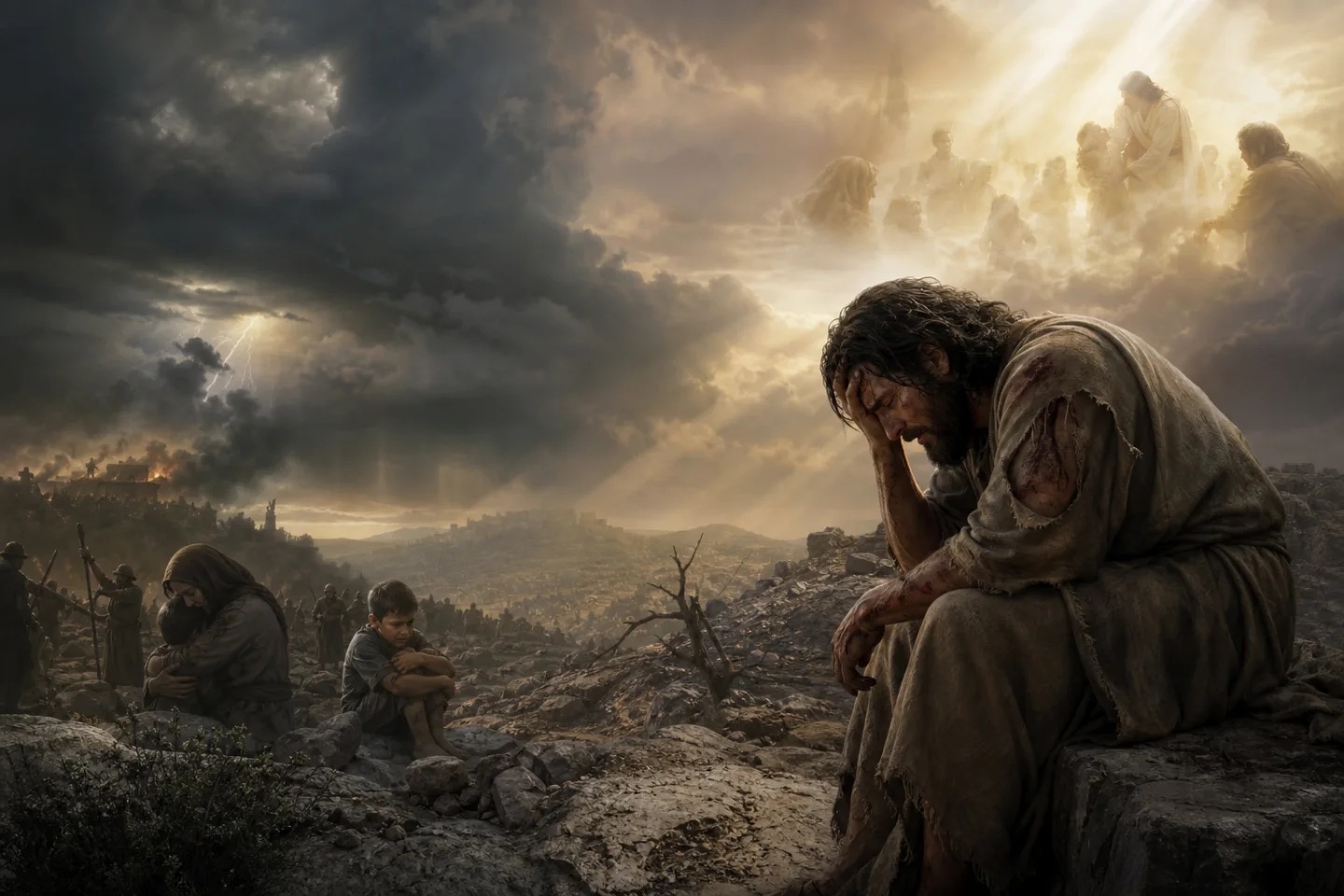
A question about suffering can be philosophical until suffering becomes personal. Then an answer that once sounded convincing may feel painfully small. Job 1:20–22, Job 2:9–10, and Romans 8:18–28 do not supply a complete account of why every tragedy happens. Their contribution is different: they show grief and trust occupying the same life, and hope surviving without a timetable. Job mourns openly. Creation groans. People who have the Spirit groan too. These are not embarrassing details to move past on the way to an optimistic conclusion. They shape what the passages mean. A reading that makes faithful people appear untouched by sorrow would leave out some of their clearest statements.
The wider world is waiting, not already healed
Romans 8 describes creation as subject to vanity and bound to decay, yet also placed in hope. It looks forward to liberation rather than announcing that liberation as a completed experience. The passage compares creation's groaning with the pains of childbirth: distress is real, and so is expectation. Neither part of the image cancels the other.
The same waiting reaches into the lives of believers. Those who have the first fruits of the Spirit also groan within themselves, awaiting adoption, described here as the redemption of the body. Their hope is not simply an escape into pleasant thoughts. It concerns embodied life, the very place where weakness and suffering are experienced.
This matters when faith is treated as protection from every painful circumstance. Romans does not divide the world into suffering unbelievers and comfortable believers. It explicitly includes people with the Spirit among those who groan. Their condition is not presented as evidence that hope has failed; it is the condition in which they continue to hope.
The comparison with future glory in verse 18 therefore changes the horizon, not the reality of the wound. It does not say that present pain is imaginary or that another person's grief is too small to deserve attention. The future described by the passage is greater than the present, but the present still needs to be faced honestly.
Romans 8:18–28
Job's worship does not erase his grief
Job's response is physical and visible. He rises, tears his robe, shaves his head, falls to the ground, and worships. The narrator places signs of mourning and an act of devotion together. There is no instruction in these verses to replace grief with a cheerful appearance before approaching God.
> He said, “Naked I came out of my mother’s womb, and naked will I return there. The LORD gave, and the LORD has taken away. Blessed be the LORD’s name.”
Job 1:21 — World English Bible
Spoken by a grieving person, these words acknowledge dependence rather than control. Job cannot hold his life and possessions in place by force. His response can be read as trust in the middle of loss, but it is not a detailed explanation of every event that produced that loss. The distinction is important: a confession from within suffering is not the same thing as a command imposed on someone else.
The narrator adds that Job did not sin or charge God with wrongdoing in this response. That judgment concerns the scene before us. It should not be expanded into a rule that every difficult question, every tear, or every moment of confusion in a bereaved person's life is a failure of faith. The text shows what Job did here; it does not provide a complete inventory of acceptable emotions.
Job 1:20–22
Trust can be difficult without becoming meaningless
In Job 2:9–10, Job's wife challenges his continued integrity. He responds by asking whether good should be received from God while adversity is refused. The narrator again speaks of his conduct, saying that he did not sin with his lips. The short exchange leaves the strain of the situation visible rather than resolving it through a full explanation.
The force of Job's response lies in his continued relationship with God under pressure. It need not be turned into a demand that everyone else immediately speak with the same firmness. As a pastoral application, the passage calls for respect for the difficulty of trust when life is painful. It does not license impatience toward people who struggle to find words.
Nor do these selected verses give us a method for diagnosing another person's guilt from their suffering. They do not establish that greater pain proves weaker faith. An argument of that kind would add a conclusion the passages do not state. Their limits matter precisely because the subject is so personal: certainty should not be manufactured where the evidence is silent.
Job 2:9–10 · Job 1:20–22
Hope leaves space for not knowing when
Romans 8:24–25 explains that hope concerns what is not yet seen. If the promised reality were fully present, the nature of waiting would be different. Patience belongs to the interval. Nothing in these verses supplies a date by which a particular loss, illness, or difficult situation must be resolved.
That is why hopeful speech should not become a prediction: the passage does not guarantee that someone will soon understand a tragedy or receive the outcome they desire. Its claim is not that we can map the next few weeks. It is that decay and suffering do not exhaust the future toward which creation and believers are waiting.
Read this way, patience need not mean uninterrupted composure. Some days of waiting may include confusion or an inability to pray. Romans itself moves from hope to weakness in prayer, so those experiences are not outside its field of vision. The person who cannot explain what they need is not excluded from the help the passage announces.
Romans 8:18–28
Prayer when a person has no clear request
> In the same way, the Spirit also helps our weaknesses, for we don’t know how to pray as we ought. But the Spirit himself makes intercession for us with groanings which can’t be uttered.
Romans 8:26 — World English Bible
The admission that we do not know how to pray as we ought is followed by help, not abandonment. The Spirit intercedes, and the one who searches hearts knows the Spirit's mind. Prayer is not presented as a performance in which a suffering person must first achieve perfect clarity.
A pastoral reading can draw comfort from that movement. The whole burden is not placed on the individual's ability to find the right sentence or understand the right outcome. This does not promise an instant change of feeling. It locates help in weakness rather than making emotional strength the entry requirement for hope.
Romans 8:18–28
Working for good does not make every harmful event good
Romans 8:28 speaks about all things working together for good for those who love God and are called according to his purpose. The statement follows the discussion of groaning, patience, and intercession. It should be read alongside those realities, not used to make them disappear.
There is a difference between trusting God's purpose and declaring every hurtful act good in itself. The verse also does not reveal to an observer the specific reason for another person's loss. Confidence in God need not become confidence in our own explanation of someone else's pain.
That distinction changes how hope can be shared. We can listen without assigning blame, remain present without forcing a conclusion, and acknowledge grief without abandoning faith. These are pastoral applications, not additional promises inserted into the passages. They follow the direction of texts that allow Job's mourning and creation's groaning to remain audible.
Romans 8:18–28 · Job 1:20–22
Conclusion
Job and Romans offer no shortcut around suffering. They give language for a relationship with God that survives unanswered questions, and for a hope that can wait without pretending to possess everything already. Sometimes the most faithful response is not a comprehensive explanation, but room to grieve and the refusal to leave the sufferer alone with the demand to understand.
Biblical references
- Job 1:20–22
- Job 2:9–10
- Romans 8:18–28