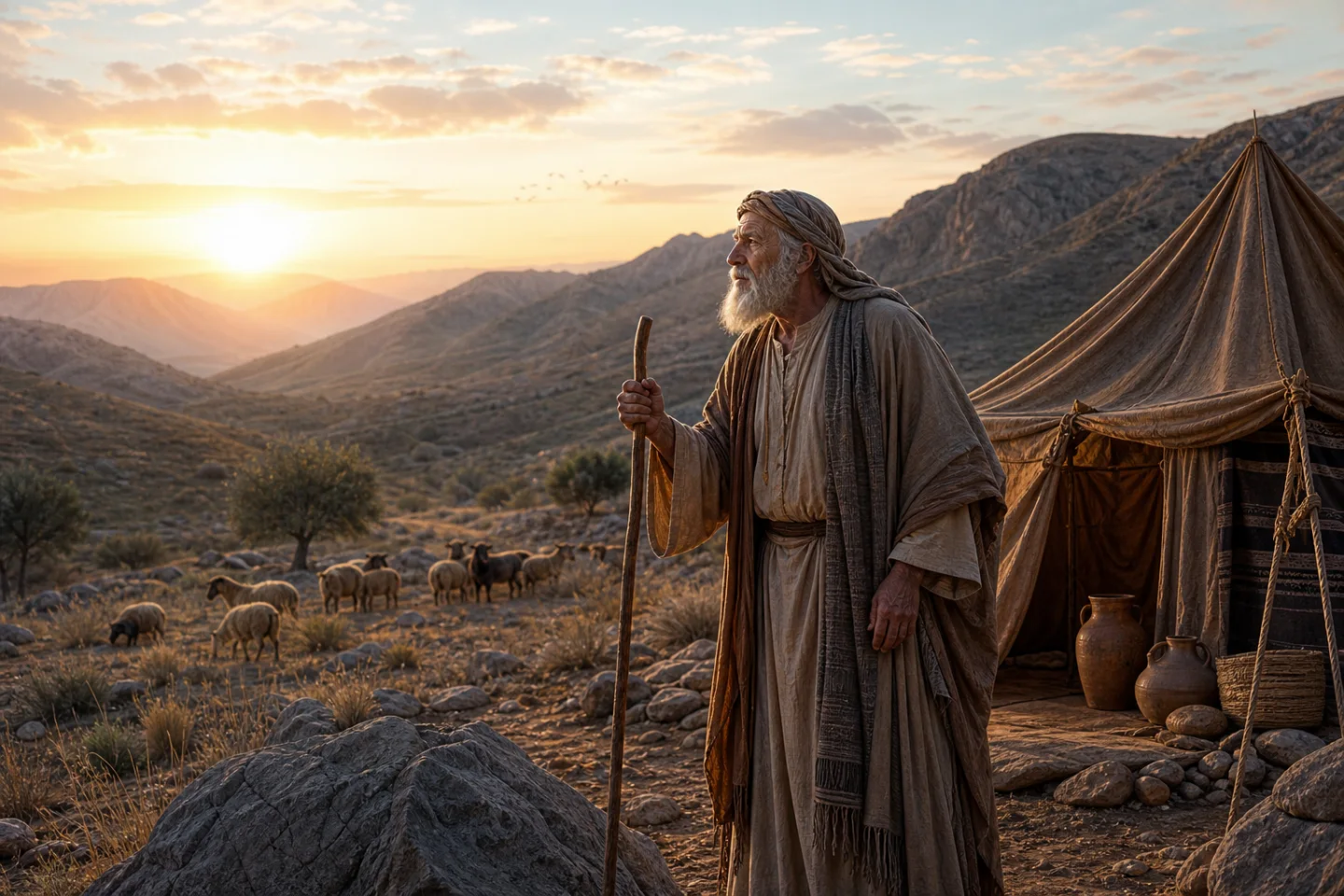
Before Israel crosses the sea, the people imagine that leaving Egypt has led them into disaster. They see the Egyptians coming, cry out to the LORD, and accuse Moses of bringing them into the wilderness to die. Exodus 14:10–31 begins with fear, not with a confident people already certain how the story will end. The sequence that follows is more than an image of divided water. Protection precedes the crossing; a command to stand still is followed by a command to move; the dry path becomes the setting of both escape and judgment. At the end, the people's attention is fixed on an act the passage attributes to the LORD.
The threat narrows what Israel can imagine
Israel's complaint presents two possibilities: service to the Egyptians or death in the wilderness. The people say the former would have been better. Their words turn departure from Egypt into an accusation against Moses, even while they cry out to God in fear.
The narrator allows this response to remain part of the story. Israel is not portrayed as a community whose faith must become flawless before deliverance is possible. The fearful complaint belongs to the situation in which the coming action occurs.
As a reading of the human scene, the danger makes even servitude appear preferable to an uncertain future. Fear constricts the possibilities the people can see. The narrative will introduce an opened way that is not contained in the alternative their complaint has offered.
Exodus 14:10–31
Moses points away from the army's power
Moses tells the people not to be afraid, to stand still, and to see the salvation the LORD will accomplish that day. His assurance directs their attention away from their own ability to overcome the pursuing army.
> The LORD will fight for you, and you shall be still.”
Exodus 14:14 — World English Bible
The next verse contains a command to go forward. God asks why Moses cries out and tells him to instruct Israel to move. Moses is to lift his rod and stretch his hand over the sea, so the people may pass through its midst on dry ground.
The two instructions should be heard within the same sequence. Trusting that the LORD will fight is not identical to refusing to move when a way is provided. A coherent interpretation distinguishes confidence in divine action from the response that action calls forth. The people will walk, but the narrative does not say they create the deliverance by their own strength.
Exodus 14:10–31
A barrier of protection through the night
The angel of God moves from the front of Israel's camp to the rear. The pillar of cloud also moves behind them, taking a position between the camp of Israel and the Egyptian camp. The passage describes cloud and darkness, with light for Israel by night, and says the two do not come near one another during that night.
This stage is easy to overlook when all attention goes to the divided sea. Yet it contributes to the story's movement: protection is present while danger remains, not only after Israel reaches the far side. The separation of the camps belongs to the period before the crossing is completed.
The pillar is not described as an object Israel manipulates. Its movement is part of God's activity in the account. The story places the people within protection they receive, while preparing them to obey the instruction to advance.
Exodus 14:10–31
The east wind and the dry path
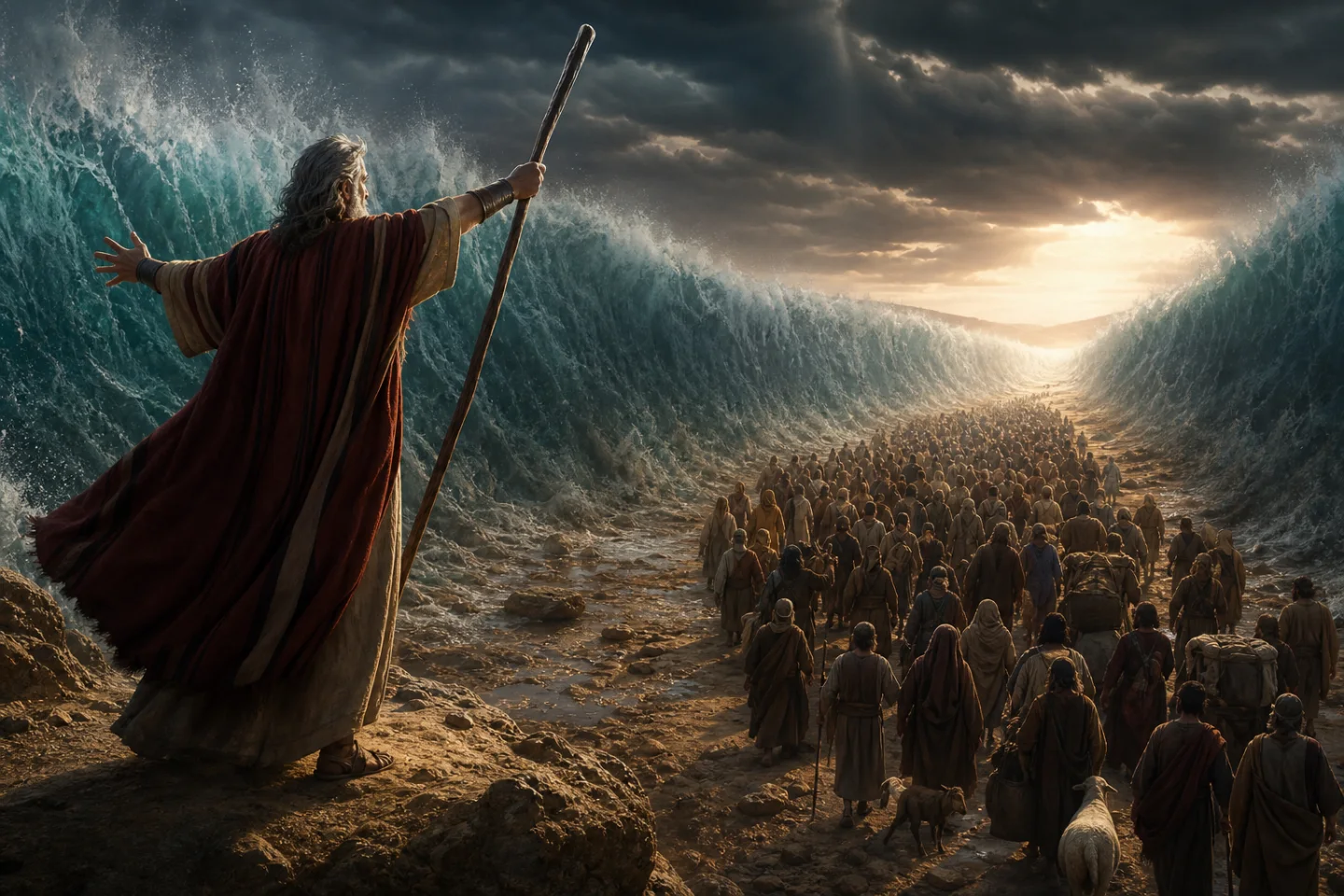
Moses stretches his hand over the sea, and the LORD causes it to go back by a strong east wind throughout the night. The waters are divided and the sea becomes dry land. Israel enters, with the waters described as a wall on the right and on the left.
The wind is not offered as an alternative to divine action. The text includes it in the action attributed to the LORD. Likewise, the duration of the night belongs to the description. The account need not be rewritten as an instantaneous spectacle in order to preserve its presentation of extraordinary deliverance.
The Egyptians then follow Israel into the sea with horses, chariots, and horsemen. During the morning watch, the LORD looks upon the army through the pillar of fire and cloud and throws it into confusion. The chariots are impeded, and the Egyptians themselves say that the LORD is fighting for Israel against them.
Exodus 14:10–31
The return of the waters is a judgment, not a minor obstacle
God tells Moses to stretch his hand over the sea again. At the approach of morning, the waters return and cover the chariots, horsemen, and army that have entered in pursuit. The passage states that none of that pursuing force remains.
This is a grave ending. The rescue of Israel is told together with the lethal defeat of its pursuers. A careful reading should neither erase that judgment nor make the deaths a source of entertainment. Both the deliverance and its severity are part of the account's presentation.
Israel, by contrast, walks through the sea on dry ground. The detail of the waters as a wall is repeated. The narrator summarizes the day as the LORD saving Israel from the hand of the Egyptians and describes Israel seeing the Egyptians dead on the shore.
Exodus 14:10–31
What changes in the people who have crossed?
Exodus 14:31 emphasizes what Israel has seen: the great work of the LORD against the Egyptians. The people fear the LORD and believe in him and in Moses his servant. This ending differs sharply from the opening scene of terror before the army.
The change is not simply a more pleasant emotional state. Trust is directed toward the one to whom the narrative attributes salvation. Moses is identified as the LORD's servant, not as a man possessing an independent method for controlling water.
A Christian reflection may find in this movement a call to trust and respond when a way is not yet visible. It remains an application of a particular narrative. The account does not turn every personal problem into a guarantee of an identical miracle, or provide a technique by which such an event can be repeated on demand.
Exodus 14:10–31
Conclusion
The sea crossing moves from a people trapped within fearful alternatives to a people recognizing deliverance. Between those scenes lie God's protection, the command to advance, the opened path, and judgment on the pursuers. Following that sequence keeps the story's force grounded in what it actually narrates.
Biblical references
- Exodus 14:10–31