
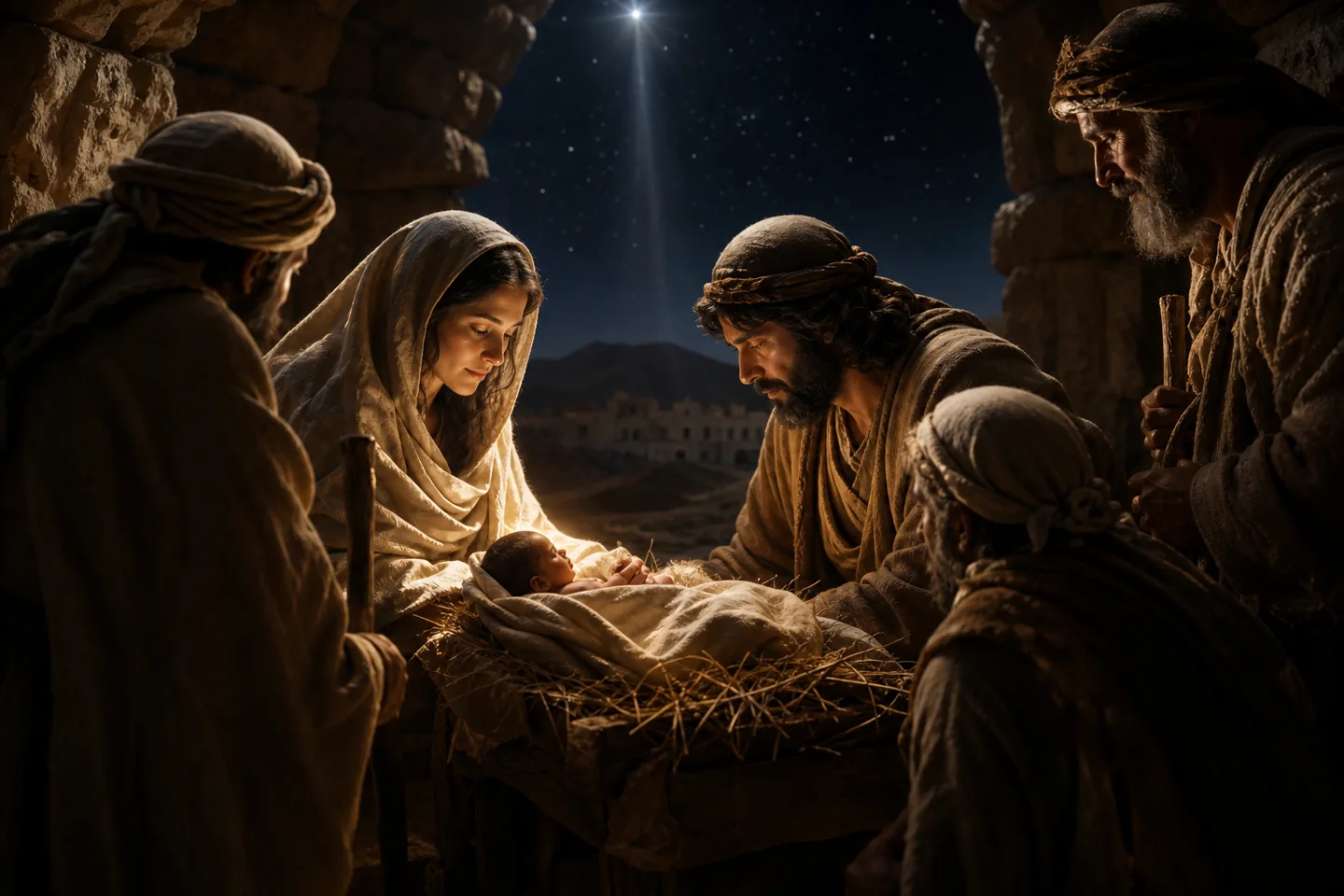
A powerful ruler is not the only image that appears when these passages are read together. There is also a despised servant, a small place named Bethlehem, and a child whose mission concerns the sins of his people. The Christian reading of the promised Messiah connects these elements with Jesus without requiring that all three passages be treated as one continuous quotation. The sources for this study are Isaiah 53:1–12, Micah 5:2, and Matthew 1:20–23. They are enough for a focused exploration, not for a complete catalogue of messianic prophecy. The task is to notice what each contributes and to keep textual statements distinct from the Christian interpretation that relates them.
Matthew gives the child a name and a mission
Matthew describes an angel appearing to Joseph in a dream. Joseph is addressed as a son of David and told not to be afraid to take Mary as his wife, because what is conceived in her is of the Holy Spirit. The announcement then turns to the son she will bear.
> She shall give birth to a son. You shall name him Jesus, for it is he who shall save his people from their sins.”
Matthew 1:21 — World English Bible
The explanation of the name is tied directly to salvation from sins. In this passage, Jesus is not introduced merely as a child whose arrival improves the family's circumstances. His mission is stated in relation to his people and their sins. A reading that replaces this with a vague promise of prosperity would remove the announcement's specific focus.
Matthew then says these events fulfill what the Lord spoke through a prophet. The quotation concerns a virgin conceiving and giving birth to a son who is called Immanuel, explained as God with us. Naming Jesus and explaining Immanuel occur within the same account, contributing different aspects of its presentation.
The narrative thus speaks both of salvation and of God's presence. It does not need to be divided into unrelated stories to preserve the distinction between the angel's naming instruction and the prophetic quotation. Each performs its own role within Matthew's explanation.
Matthew 1:20–23
Isaiah begins with rejection rather than recognition
Isaiah 53 opens with questions about believing the message and the revelation of the LORD's arm. The figure described grows like a tender plant and a root from dry ground. He has no attractiveness or majesty that makes the observers desire him, and he is despised, rejected, and acquainted with suffering.
The passage creates a contrast between the observers' first judgment and the meaning later attributed to the suffering. The one not esteemed becomes central to the announcement. The description is not a portrait of someone winning recognition through obvious status or outward appeal.
In verses 4–6, the speech shifts toward what he carries for others. Sickness, suffering, transgression, iniquity, peace, and healing enter the account. Those speaking acknowledge that they have gone astray like sheep, each following a separate way, while the LORD lays their iniquity on him.
Isaiah 53:1–12
The servant's suffering has a stated relation to sin
> But he was pierced for our transgressions. He was crushed for our iniquities. The punishment that brought our peace was on him; and by his wounds we are healed.
Isaiah 53:5 — World English Bible
The poem does not present suffering only as misfortune. It relates the servant's wounds to the wrongs of others and to their peace. Christian interpretation finds in this a way of understanding salvation through Jesus' suffering. That connection should be identified as Christian interpretation: the name Jesus does not occur within these verses of Isaiah themselves.
The servant is oppressed and silent, compared with a lamb led to slaughter. The passage describes his being cut off from the land of the living and speaks of his burial, while affirming that he has done no violence and spoken no deceit. The final verses also describe a future outcome: offspring, prolonged days, satisfaction, the justification of many, and the bearing of their iniquities.
Both sides belong to the chapter's movement. A reading focused only on humiliation would miss its language of outcome and vindication. Equally, the healing language should not automatically be turned into a guarantee that every reader will receive immediate physical recovery. The poem places it within a larger treatment of sin, peace, and the servant's work.
Isaiah 53:1–12
Micah locates a ruler's emergence in small Bethlehem
Micah 5:2 addresses Bethlehem Ephrathah as small among the clans of Judah. From there will come a ruler in Israel. The verse also speaks of his origins or goings out as being from ancient times, using the language preserved in the translation.
Smallness and future rule are set together. This invites a reading in which the apparent importance of the place does not determine the weight of the promise. The verse contributes a location to the expectation, but by itself it does not provide a full chronology or explain every aspect of the ruler's identity.
Christian readers can place this expectation alongside Matthew's announcement of Jesus. The connection must not be confused with a claim about what the selected Matthew passage explicitly quotes. Matthew 1:20–23 concerns Joseph, Mary, the child's name, and Immanuel; it does not narrate a visit to Bethlehem or directly quote Micah 5:2 here.
Micah 5:2 · Matthew 1:20–23
Connecting the passages without merging their voices
Isaiah describes a servant whose suffering is related to the sins of many. Micah speaks of a ruler in relation to Bethlehem. Matthew names Jesus and interprets his birth through salvation and fulfillment. A Christian synthesis can bring these contributions into conversation, but the synthesis should not be passed off as a sentence spoken identically in all three sources.
In particular, the Immanuel quotation in Matthew should not be attributed to Micah 5:2, and it should not be identified with Isaiah 53. The selections do not support either move. Keeping the references distinct protects the reader from a form of summary that sounds biblical while actually combining different texts inaccurately.
Genre and speaker also matter. Isaiah includes a confession about the servant and his significance for others. Matthew recounts an announcement to Joseph and explains fulfillment. The servant can be read in the light of Jesus without inserting Jesus' name into a quotation where it is not present.
A helpful reading practice is therefore to ask two questions separately: what does this passage say in its own words, and how does a Christian interpretation relate it to Jesus? Distinguishing the questions does not prevent faith. It makes the connection more accountable to the texts being read.
Isaiah 53:1–12 · Micah 5:2 · Matthew 1:20–23
Conclusion
These passages bring together expectations of rule, the weight of suffering, salvation from sin, and God's presence. Matthew explicitly identifies the child as Jesus; Christian interpretation reads the other voices in relation to him. The strength of that reading lies not in collapsing the sources, but in allowing their different contributions to remain clear.
Biblical references
- Isaiah 53:1–12
- Micah 5:2
- Matthew 1:20–23