The stories of Abraham, Isaac, and Jacob can be linked without making the three men interchangeable. In the selected passages, Abram is told to leave, Isaac is told where to remain, and Jacob hears a promise of protection and return while traveling. The thread is a renewed promise rather than a repeated set of circumstances. This introduction to Israel's patriarchs follows Genesis 12:1–9, 26:1–5, and 28:10–15. It is a sequence of scenes, not a complete genealogy or biography. Land, offspring, blessing, and presence provide the connections the passages themselves place before the reader.
Three situations in the order of Genesis
Genesis 12 describes Abram's departure from Haran and arrival in Canaan. Genesis 26 opens with famine and a word to Isaac in connection with the oath sworn to Abraham. Genesis 28 follows Jacob toward Haran and recounts a dream with a promise from the God of Abraham and Isaac.
This order is useful because the links are not supplied only by a reader arranging similar stories. The later speeches explicitly recall the earlier names and commitments. At the same time, each scene has a distinct immediate concern. Recognizing both continuity and difference prevents a broad summary from swallowing the individual narratives.
Genesis 12:1–9 · Genesis 26:1–5 · Genesis 28:10–15
Abram leaves in response to a promise
The LORD tells Abram to leave his country, relatives, and father's house for the land he will be shown. The word announces a great nation, blessing, a great name, and blessing through him for all the families of the earth. The horizon extends beyond Abram's private household even while the instruction is addressed to him.
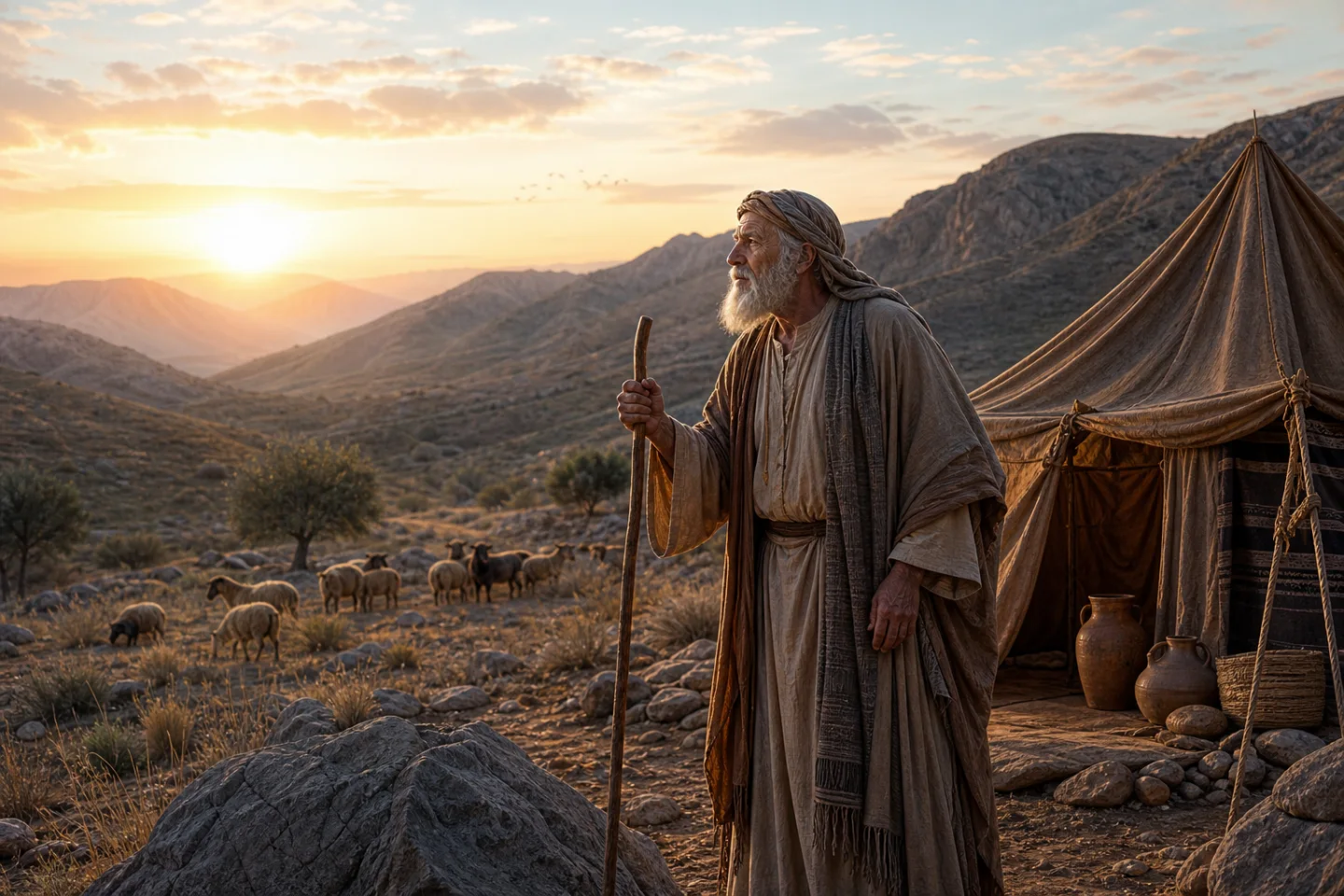
Abram departs from Haran at seventy-five. Sarai his wife, Lot his brother's son, their possessions, and the people acquired in Haran travel with him. They enter Canaan. The promise is set within the movement of a household, not only within an inward experience of the individual.
At Shechem, near the oak of Moreh, the LORD appears and promises the land to Abram's offspring. Abram builds an altar. He then pitches his tent east of Bethel, with Bethel to the west and Ai to the east, builds another altar, and calls on the LORD's name. The selection ends as he continues southward.
The scene joins a spoken future to present action. Abram does not already hold every promised outcome. He travels and worships while the word remains ahead of him. The tent and the altars give the response a visible form without turning arrival into complete fulfillment.
Genesis 12:1–9
Isaac is told to stay in the appointed land
Genesis 26:1–5 begins with famine and mentions an earlier famine in Abraham's days. Isaac goes to Abimelech, king of the Philistines, in Gerar. The LORD appears to him and tells him not to go down into Egypt but to live in the land he will be told about.
> Live in this land, and I will be with you, and will bless you. For I will give to you, and to your offspring, all these lands, and I will establish the oath which I swore to Abraham your father.
Genesis 26:3 — World English Bible
Abraham is explicitly called Isaac's father in this speech. The oath sworn to him is renewed in relation to Isaac, with promises of land, offspring as numerous as the stars, and blessing for the nations. The passage also recalls Abraham's obedience to God's voice, requirements, commandments, statutes, and laws.
Abram's instruction to leave and Isaac's instruction not to go down to Egypt should not be flattened into the same action. The continuity is in God's word and commitment, not in copying every movement of the previous figure. A particular instruction meets Isaac's particular situation.
The speech also comes within the famine introduced at the start. The passage does not first announce that every need has disappeared. Presence and blessing are promised in the setting of a difficulty, where Isaac must respond to what is being said.
Genesis 26:1–5 · Genesis 12:1–9
Jacob hears about presence in the middle of a journey
Genesis 28:10–15 places Jacob on the road from Beersheba toward Haran. When the sun sets, he stops, takes a stone for his head, and lies down. In a dream he sees a stairway between earth and heaven, with angels ascending and descending.
The LORD identifies himself in relation to Abraham and Isaac and promises Jacob the land on which he lies. His offspring will be like the dust of the earth and will spread in every direction. The speech again extends blessing through him and his offspring to all the families of the earth.
> Behold, I am with you, and will keep you, wherever you go, and will bring you again into this land. For I will not leave you until I have done that which I have spoken of to you.”
Genesis 28:15 — World English Bible
The dream's striking image should not distract from its spoken promise. Protection along the way and a return to the land address Jacob as a traveler. The commitment not to leave him until the word is fulfilled gives the scene its assurance.
These selected verses do not recount everything that brought Jacob to this night or supply the place's later name. The encounter can be read without filling those gaps. The movement from a traveler's exposed rest to a promise of presence and future is already complete enough to understand the scene's contribution.
Genesis 28:10–15
Land, offspring, and blessing recur without becoming identical
Land appears in all three accounts, but differently. Abram moves toward it and hears it promised to his offspring. Isaac is told where to live. Jacob lies on it while hearing that he will return. Each scene attaches the promise to a particular moment of uncertainty or movement.
Offspring and blessing also connect the accounts. Genesis 12 names a great nation and all the families of the earth. Genesis 26 recalls the oath to Abraham and includes the nations again. Genesis 28 names the God of Abraham and Isaac and speaks once more of blessing reaching all families.
The repeating language establishes a shared thread, but the selections do not amount to complete biographies. Learning about each figure in full would require more of the narrative. For this focused comparison, the value lies in observing how the promises are restated rather than adding episodes not contained in the supplied passages.
Genesis 12:1–9 · Genesis 26:1–5 · Genesis 28:10–15
A sequence is not an invented calendar
The age given in this set of passages is Abram's age at departure from Haran. The other selections do not provide a complete schedule of ages and years between the scenes. The chapter order can be followed without pretending it offers all the information needed for an absolute chronology.
The chronological aim here is therefore modest: to trace the promise through the narrated encounters. It is not to calculate the total length of the patriarchal period or assign dates the selected verses do not give. That restraint protects the difference between a sequence in the story and a fully documented historical calendar.
Genesis 12:1–9 · Genesis 26:1–5 · Genesis 28:10–15
Conclusion
Departure, remaining, and traveling toward an assured return are different responses in these scenes. The shared promise does not require an identical life. A reflection on the patriarchs can therefore seek continuity in trust without turning one person's particular instruction into a rule that everyone must reproduce literally.
Biblical references
- Genesis 12:1–9
- Genesis 26:1–5
- Genesis 28:10–15