
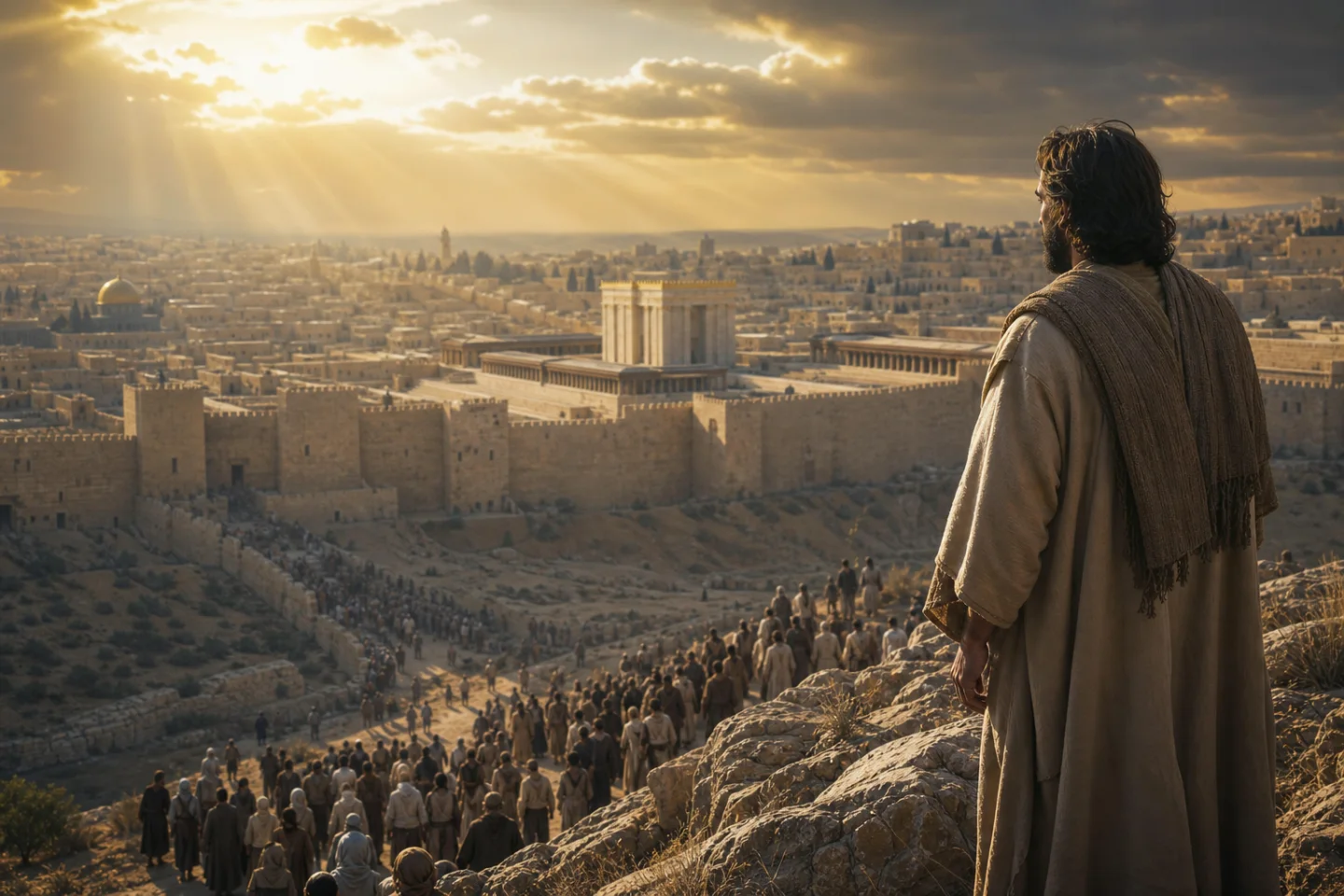
Jerusalem is more than scenery in Psalm 122 and Luke 19:41–44. One passage speaks of joyful arrival, gathered tribes, and the desire for peace. The other describes tears over the city and a warning of destruction. Their tones differ, but both treat the city's life as something that matters deeply. A reading of these passages cannot replace a full history of Jerusalem. It can ask a more focused question: how do worship, shared life, judgment, peace, and recognition shape the city in these two scenes? Keeping the scenes distinct is part of answering that question well.
A journey expressed as shared joy
Psalm 122 begins with gladness at the invitation to go to the LORD's house. It then speaks in the plural: our feet are standing within Jerusalem's gates. The change makes the arrival a shared experience rather than a purely private spiritual moment.
The direction of the journey also gives it meaning. The poem does not begin with sightseeing or with an inventory of impressive structures. Its gladness is connected to going to the LORD's house. Other people are already present in the invitation that causes the speaker to rejoice.
Jerusalem is described as a city compactly built together. The tribes go up there according to an ordinance for Israel, to give thanks to the LORD's name. Their gathering has a stated purpose. The city becomes the setting of a community directed toward thanksgiving.
Psalms 122:1–9
Worship belongs beside the language of judgment
The psalm also mentions thrones for judgment and the thrones of David's house. These appear in the same portrait as the gathering tribes and thanksgiving. The life of the city is therefore not described only through inward feeling.
The proximity of worship and judgment allows a reading in which communal responsibility belongs to the city's significance. Jerusalem is a place where people gather before God and where justice has a recognized seat in the poem's language. Neither element needs to be removed for the other to matter.
The passage does not explain the detailed operation of the courts or offer a complete description of the institutions. Its contribution is concentrated: tribes, thanksgiving, and judgment stand together. Holding them together protects the reading from becoming only admiration for a famous or beautiful place.
Psalms 122:1–9
Prayer for peace leads toward seeking good
> Pray for the peace of Jerusalem. Those who love you will prosper.
Psalms 122:6 — World English Bible
The prayer continues with peace within the walls and prosperity within the palaces. The final two verses name reasons for this concern: brothers and companions, and the house of the LORD. The speaker then commits to seeking Jerusalem's good.
The movement connects prayer with a personal disposition to act for the city's welfare. It is not merely a wish for one's own comfortable circumstances. The people who share the place and its relation to worship explain why its peace matters.
An application of the psalm may therefore ask what motivates interest in a place. Is concern limited to personal benefit, or does it include the companions whose lives are bound up with it? The poem's movement from gladness to seeking good invites a broader concern without requiring a complete program of action from these few lines.
Psalms 122:1–9
Luke's warning begins with tears
Luke 19:41 describes approaching the city, seeing it, and weeping over it. The speech that follows longs for Jerusalem to have recognized the things belonging to its peace. Those things are now described as hidden from its eyes.
The tears belong to the interpretation of the severe words that follow. The city is not treated as something worthless whose destruction can be celebrated from a distance. The narrative places grief beside warning, which should prevent a detached or triumphant reading of the predicted harm.
The warning describes enemies surrounding the city with a barricade and hemming it in on every side. It speaks of destruction affecting the city and its children, with no stone left upon another. The final reason given is failure to recognize the time of visitation.
Luke 19:41–44
A failure to recognize what leads to peace
Peace in Luke's scene is connected with recognition of a decisive moment. The passage is not simply a prediction detached from the city's response. What has not been recognized and what is now announced belong to the same explanation.
These four verses do not supply a fulfillment date or a detailed historical identification of the army. Such claims require evidence beyond this selection. A focused reading can stay with the elements Luke states: grief, unrecognized peace, the announced siege, and a missed visitation.
As a spiritual application, the scene can invite a community to examine whether it recognizes what its peace requires. That is different from using the passage to announce a specific disaster over another city. The warning is serious, but its setting in grief matters as much as its severity.
Luke 19:41–44
Connecting two voices without making them one
Psalm 122 asks for peace and ends in a commitment to seek good. Luke 19 laments failure to recognize what belongs to peace. This is a meaningful thematic connection. It does not establish that Luke's scene is a literal continuation of the psalm or that the selected verses explicitly quote it.
The different tones are part of the value of reading them together. Joy at arriving with others and sorrow at a city's condition both refuse indifference. Jerusalem emerges as a place of relationships and responsibility, not only as a name that carries associations for the reader.
A useful response may be to preserve both the gladness and the seriousness. Shared worship can produce concern for companions; concern for a city can include grief rather than denial of its need. These are ways of reflecting on the texts, not new historical statements about Jerusalem added to them.
Psalms 122:1–9 · Luke 19:41–44
Conclusion
The psalm's final movement is toward seeking the city's good. Luke's scene leaves the reader with tears over peace that has not been recognized. Together they ask whether attention to a place becomes care for those who share it and a willingness to notice what its well-being requires.
Biblical references
- Psalms 122:1–9
- Luke 19:41–44