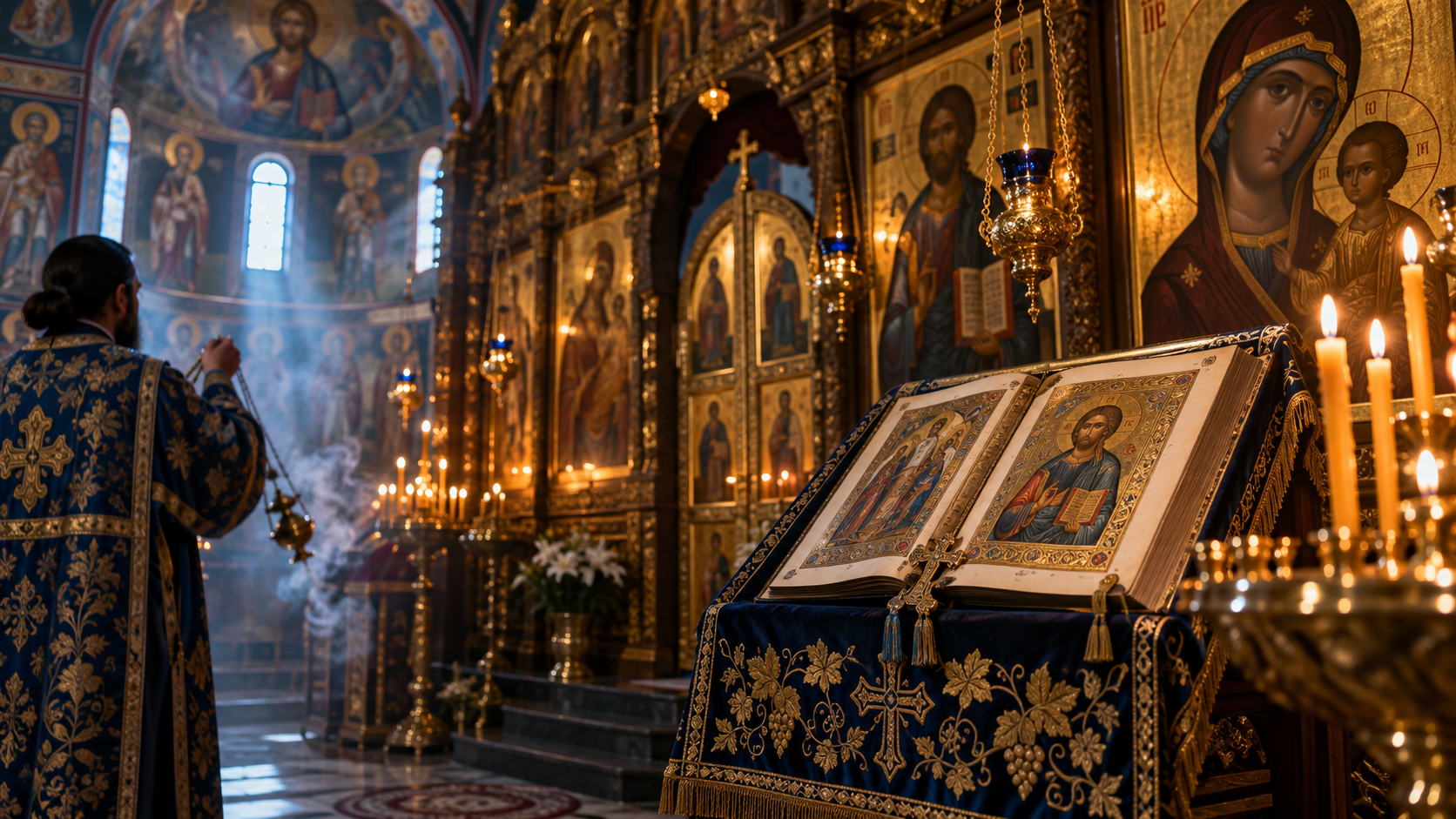
Orthodox Christianity understands itself as the faithful continuation of the ancient Church, sustained by apostolic faith, liturgy, and sacramental life. Instead of a single center comparable to the papacy, Orthodoxy is organized as a communion of local churches, each led by its bishops and united by the same faith, the same fundamental worship, and the same sacramental life.
Brief origin and history
Orthodoxy traces itself back to the early Church and gives great importance to the Church Fathers and the ecumenical councils. Historically, the split between East and West marked the separation between the Orthodox communion and the Roman Catholic Church. Orthodoxy sees itself as preserving the faith of the undivided ancient Church.
Scripture and Tradition
Orthodox Christians revere Holy Scripture as inspired by God, but always within the life of Holy Tradition. In Orthodoxy, Scripture and Tradition do not compete; Scripture belongs to the living Tradition of the Church. The liturgy, the Fathers, the councils, and the spiritual life all form part of that inheritance.
God, the Trinity, and Jesus Christ
Orthodoxy confesses one God in three Persons: Father, Son, and Holy Spirit. Jesus Christ is truly God and truly man. The incarnation, the cross, and the resurrection are central, with strong emphasis on Christ’s victory over death and on the restoration of humanity to communion with God.
The Holy Spirit
The Holy Spirit has a decisive place in the life of the Church and in Orthodox theology. Orthodox liturgy, prayer, and spirituality are deeply marked by invocation of the Spirit. Orthodoxy stresses the sanctifying work of the Spirit and the Spirit’s presence in sacramental life.
Salvation and theosis
A key Orthodox term is theosis, or deification. This does not mean that the human being ceases to be a creature, but that by grace the human person is called to participate in divine life. Salvation is described not only in legal terms but also as healing, transformation, and union with God.
Religious authority
Orthodoxy recognizes the authority of Scripture as read in the Church, Holy Tradition, the Fathers, and the ecumenical councils. There is no figure equivalent to the Pope with universal jurisdiction over the entire Orthodox communion. Authority is lived in a more conciliar and synodal way.
Sacraments and liturgy
Orthodoxy has an intensely sacramental life. It commonly speaks of seven principal mysteries, though Orthodox language is sometimes less schematic than Western formulations. The Divine Liturgy and the Eucharist occupy a central place. Orthodox Christians affirm the real presence of Christ in the Eucharist, though they do not usually explain it in the same scholastic terms found in Latin Catholic theology.
Mary and the saints
Mary is honored as Theotokos, “God-bearer” or “Mother of God.” Veneration of saints, icons, and relics is an important part of Orthodox life. Veneration is not understood as adoration, which belongs to God alone.
Church and ministry
Orthodoxy is made up of autocephalous or autonomous churches in communion with one another. Bishops hold a central place in the life of the Church. Priests and deacons share in sacramental ministry. Liturgy, the ecclesial calendar, fasting, and monastic life carry great weight in Orthodox spirituality.
The afterlife
Orthodoxy affirms the resurrection of the dead, judgment, and the life of the world to come. It speaks with reverence about the mystery of judgment and emphasizes God’s mercy and the hope of eternal life. Compared with Catholicism, Orthodoxy does not formulate the doctrine of purgatory in the same way.
Distinctive practices
Distinctive features include:
- the Divine Liturgy;
- veneration of icons;
- the centrality of Holy Tradition;
- ascetical and monastic spirituality;
- seasons of fasting;
- the language of theosis.
What to keep in mind when comparing
Orthodoxy shares much with Catholicism: Trinitarian faith, apostolic succession, sacramental life, and the veneration of Mary and the saints. At the same time, the two are distinguished by questions such as the primacy of the bishop of Rome, some doctrinal formulations developed later in the West, and certain theological and disciplinary developments. Compared with many Protestant traditions, Orthodoxy differs clearly in its understanding of Tradition, sacramentality, and the historical structure of the Church.