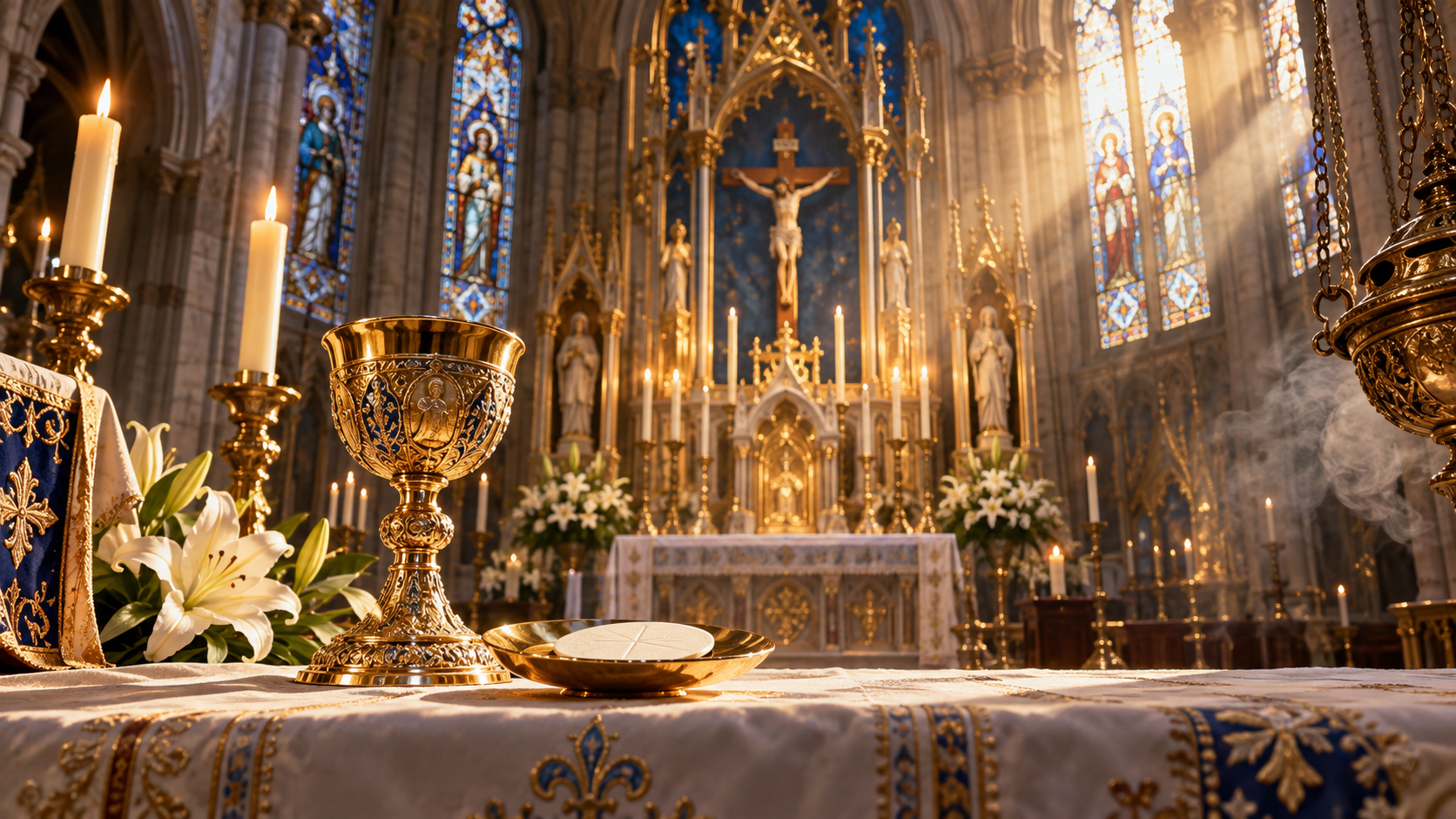
The Catholic Church understands itself as the community founded by Jesus Christ and continued in history under the guidance of the apostles and their successors. Its visible center of communion is the bishop of Rome, the Pope, and its life revolves around the proclamation of the Gospel, the celebration of the sacraments, and the universal call to holiness.
Brief origin and history
Catholic faith sees itself in continuity with the apostolic community of the New Testament. Over the centuries, the Church developed an episcopal structure, sacramental worship, and doctrinal teaching expressed in creeds, councils, and catechisms. For Catholics, this historical continuity belongs to the very identity of the Church.
Scriptures and canon
The Catholic Church receives as inspired both the Old and New Testaments. The Catholic canon includes the protocanonical books as well as the deuterocanonical books of the Old Testament. Scripture is read within the life of the Church and in relation to apostolic Tradition.
God, the Trinity, and Jesus Christ
The Catholic Church professes one God in three Persons: Father, Son, and Holy Spirit. Jesus Christ is true God and true man, the eternal Son of the Father made flesh for the salvation of the world. His death and resurrection stand at the center of Catholic faith and worship.
The Holy Spirit
The Holy Spirit is the third Person of the Trinity. The Church teaches that the Spirit sanctifies, guides the Church, inspires Scripture, and sustains Christian life. Catholic teaching also links the Spirit to the sacraments and to the Church’s mission in the world.
Salvation
Salvation is the work of God’s grace revealed in Jesus Christ. The Catholic Church teaches that no one saves himself by his own strength, yet it also teaches that grace truly transforms the person and calls believers to a life of faith, hope, and charity. For that reason, Catholic life does not set faith and works of love against one another as enemies: good works are understood as the fruit of grace.
Religious authority
Doctrinal authority in Catholicism is articulated around Scripture, Tradition, and the Magisterium. The Magisterium is the Church’s teaching office, exercised in a special way by the bishops in communion with the Pope. Catholicism does not view the Bible as a text isolated from the community that received and transmits it.
Sacraments
The Catholic Church recognizes seven sacraments:
- Baptism
- Confirmation
- Eucharist
- Penance or Reconciliation
- Anointing of the Sick
- Holy Orders
- Matrimony
The Eucharist has a central place. The Church teaches the real presence of Christ in the sacrament and regards the Mass as the sacramental memorial of Christ’s sacrifice.
Mary and the saints
Mary has a unique place as the mother of Jesus and, in Catholic faith, Mother of the Church. Catholics venerate her, but do not worship her. Catholics also honor the saints as witnesses of God’s grace and ask for their intercession. This is clearly distinguished from adoration, which belongs to God alone.
Church and ministry
The Catholic Church has a sacramental and hierarchical structure with bishops, priests, and deacons. The Pope exercises a ministry of universal primacy. The life of the Church includes liturgy, catechesis, charity, mission, and multiple forms of consecrated life.
The afterlife
The Church teaches that human history moves toward God’s judgment. It affirms the reality of heaven and hell, as well as the hope of the resurrection of the dead. It also teaches purgatory as a final purification for those who die in God’s grace but still need purification.
Distinctive practices
Distinctive Catholic practices include:
- participation in the Mass;
- sacramental life;
- liturgical and devotional prayer;
- veneration of Mary and the saints;
- the liturgical calendar;
- recognition of the teaching authority of the Pope and councils.
What to keep in mind when comparing
When Catholicism is compared with other traditions, major themes usually include the place of Tradition, the role of the Pope, the number and meaning of the sacraments, the doctrine of the Eucharist, and the veneration of Mary and the saints. At the same time, Catholicism shares with other branches of Christianity the Trinitarian confession, faith in Jesus Christ, and the central use of the Bible.