Jesus’ baptism raises an immediate question: why does someone presented in the New Testament as without sin enter a baptism associated with repentance? The Gospels do not portray the event as Jesus confessing personal guilt. Instead, they place it at the threshold of his public ministry and draw attention to his obedience, the descent of the Spirit, and the Father’s voice. The best way to read the scene is to follow what each Gospel actually says before turning it into an automatic answer to later debates about Christian baptism.
Jesus Comes to the Jordan to Be Baptized by John
Jesus comes from Galilee to the Jordan to be baptized by John. The setting matters because John’s ministry calls Israel to repentance and prepares the way of the Lord. Matthew and Mark portray Jesus entering that public movement, while Luke places the event within the wider baptism of the people. The scene stands near the beginning rather than the end of Jesus’ public story. The Jordan therefore becomes a threshold: the one who has not yet occupied the center of the Gospel narrative now steps openly into the mission John has been announcing.
Mateo 3:13 · Marcos 1:9 · Lucas 3:1–6 · Marcos 1:4–8
“To Fulfill All Righteousness”: Jesus’ Answer to John’s Objection
Matthew preserves a dialogue that states the difficulty directly. John hesitates because he recognizes an asymmetry between himself and Jesus. Jesus answers that the baptism should proceed in order to fulfill all righteousness. The verse does not provide a complete definition of that expression, but its setting supports a reading of obedience to God’s purpose and solidarity with the people Jesus has come to serve. Hebrews presents Jesus as without sin, so the event should not be treated as a confession of personal wrongdoing. His baptism belongs to his obedient mission rather than to a need for repentance.
Mateo 3:14–15 · Hebreos 4:15 · Hebreos 7:26 · Mateo 3:15
Open Heavens, the Spirit, and the Voice: What the Gospels Describe
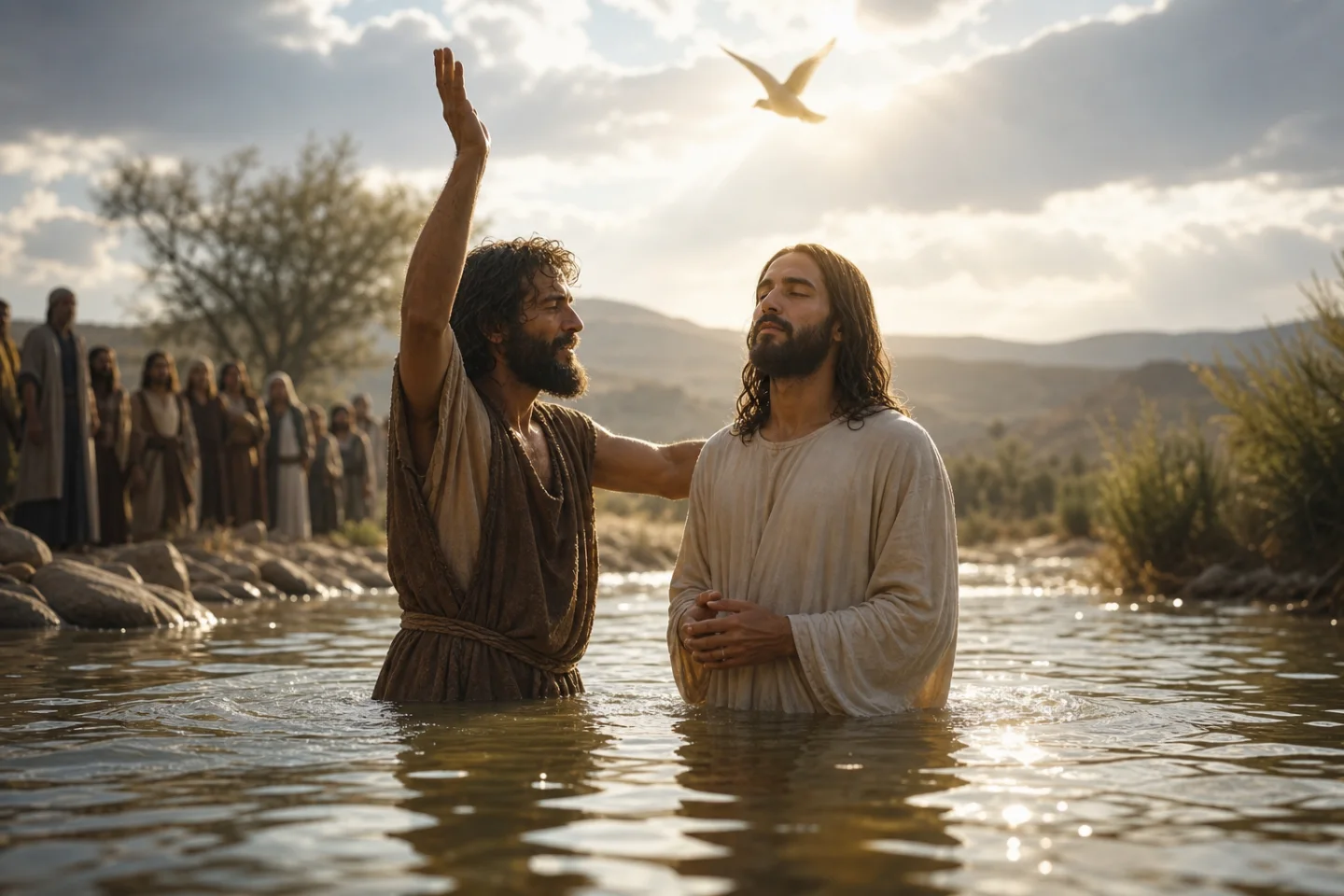
After the baptism, the Synoptic Gospels describe a tightly focused sequence: Jesus comes up from the water, heaven opens, the Spirit descends in a dove-like form, and a heavenly voice identifies him as the beloved Son. Matthew phrases the voice for those hearing it, while Mark and Luke preserve a direct address to Jesus. Luke also mentions that Jesus is praying. These variations do not erase the shared core. The scene brings Jesus, the Spirit, and the Father’s voice together at the beginning of the ministry and publicly marks divine approval and identity.
Mateo 3:16–17 · Marcos 1:10–11 · Lucas 3:21–22
What the Scene Declares About Jesus’ Identity and Mission
The voice from heaven and the descent of the Spirit are not decorative details. The language of sonship and divine pleasure resonates with themes found in Psalm 2 and Isaiah 42, directing the reader toward identity and mission. Those connections should be presented as thematic echoes rather than as if the baptism scene were itself a complete doctrinal formula. Because Father, Son, and Spirit are simultaneously present, the passage later became important in Christian Trinitarian reflection. Still, the episode’s immediate purpose is concrete: it identifies Jesus and inaugurates the mission about to unfold.
Mateo 3:16–17 · Marcos 1:10–11 · Lucas 3:22 · Salmos 2:7 · Isaías 42:1 · Lucas 3:21–22
John’s Later Testimony: The One Who Baptizes with the Holy Spirit
The Fourth Gospel contributes from a different angle. Rather than narrating the baptism in the same way as the Synoptics, it records John the Baptist’s testimony that he saw the Spirit descend and remain on Jesus. John connects that sign with the one who baptizes in the Holy Spirit. His own water baptism is distinguished from the work attributed to Jesus. This distinction cautions against treating John’s baptism as identical in every respect with later Christian practice. The witness redirects attention away from the forerunner and toward Jesus as the one upon whom the Spirit remains.
Juan 1:29–34 · Marcos 1:7–8 · Juan 3:22–30 · Hechos 19:1–5
Baptism as the Threshold of Public Ministry
The position of the baptism in the Gospel sequence also matters. In Matthew, Mark, and Luke, it is followed by the temptation and then the beginning of public proclamation. Acts 10 later remembers Jesus’ ministry from the baptism announced by John and describes God anointing him with the Holy Spirit and power. The baptism therefore functions as a narrative threshold and confirmation of mission. It should not be read as the moment when Jesus first became the Son of God; the wider New Testament places his identity beyond this single event.
Mateo 4:1–17 · Marcos 1:12–15 · Lucas 4:1–15 · Hechos 10:37–38 · Hechos 13:23–25 · Mateo 3:13–17 · Marcos 1:9–15 · Lucas 3:21–23
How to Read Jesus’ Baptism Without Turning It into an Automatic Answer to Every Baptism Debate
The baptism should first be read for what it reveals about Jesus: obedience, the purpose of God, the presence of the Spirit, and the Father’s declaration. Only then should it be related to later teaching about Christian baptism. Acts itself distinguishes John’s baptism from later developments associated with Jesus’ name and the gift of the Spirit. The Jordan scene therefore should not be used as a stand-alone solution to every baptismal controversy. Its center of gravity is the identity and mission of Jesus as he begins his public work.
Mateo 3:13–17 · Hechos 1:4–5 · Hechos 19:1–5
Conclusion
Jesus’ baptism is first a scene of identity, obedience, and mission. He enters John’s waters, the Spirit descends, and the Father’s voice identifies him as the beloved Son. From there the Gospel narratives move toward temptation and public ministry. The event illuminates the relationship of Father, Son, and Spirit and helps frame Jesus’ mission, while its own historical and narrative context should be respected when it is later compared with Christian baptism.
Biblical references
- Mateo 3:13
- Marcos 1:9
- Lucas 3:1–6
- Marcos 1:4–8
- Mateo 3:14–15
- Hebreos 4:15
- Hebreos 7:26
- Mateo 3:15
- Mateo 3:16–17
- Marcos 1:10–11
- Lucas 3:21–22
- Lucas 3:22
- Salmos 2:7
- Isaías 42:1
- Juan 1:29–34
- Marcos 1:7–8
- Juan 3:22–30
- Hechos 19:1–5
- Mateo 4:1–17
- Marcos 1:12–15
- Lucas 4:1–15
- Hechos 10:37–38
- Hechos 13:23–25
- Mateo 3:13–17
- Marcos 1:9–15
- Lucas 3:21–23
- Hechos 1:4–5