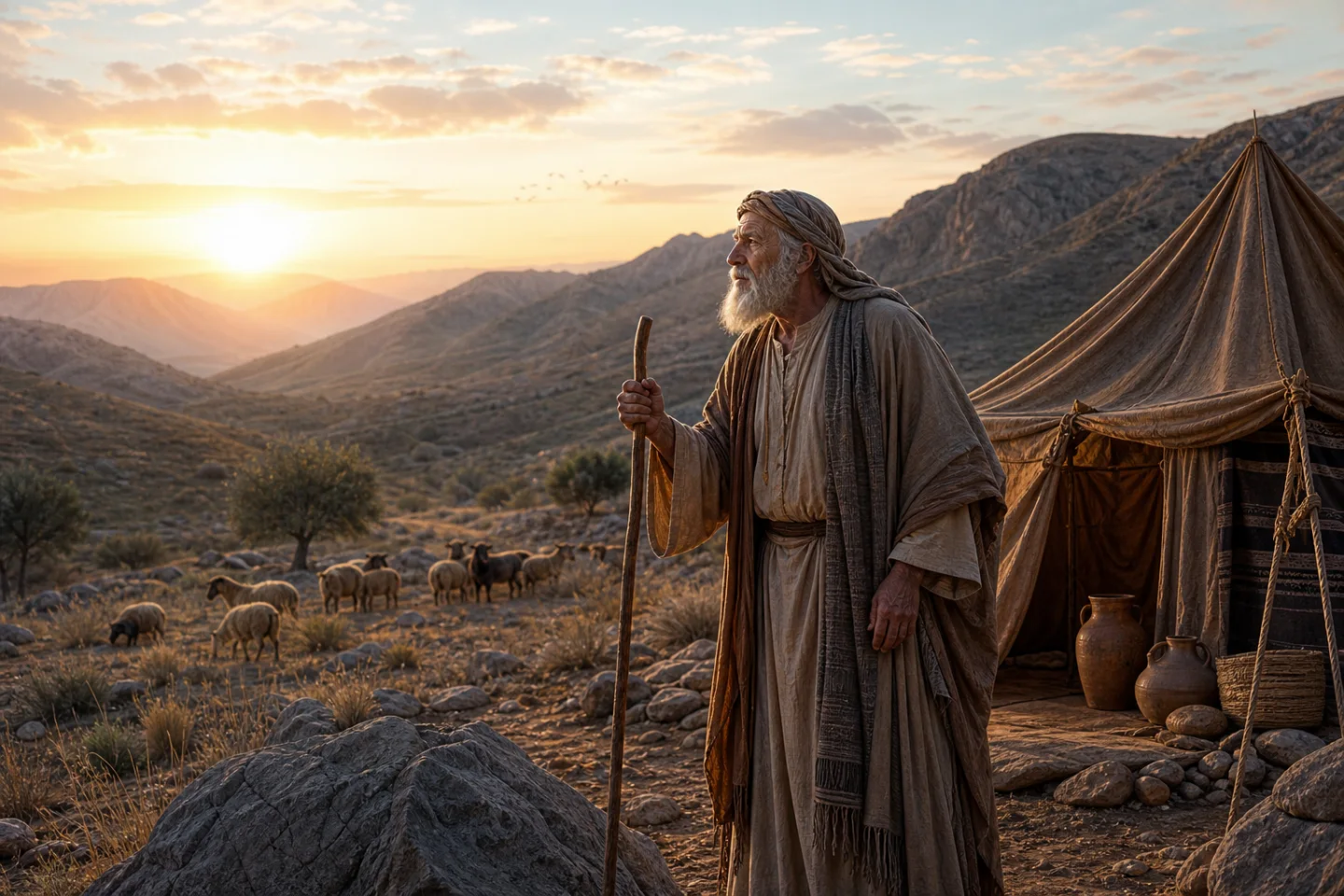
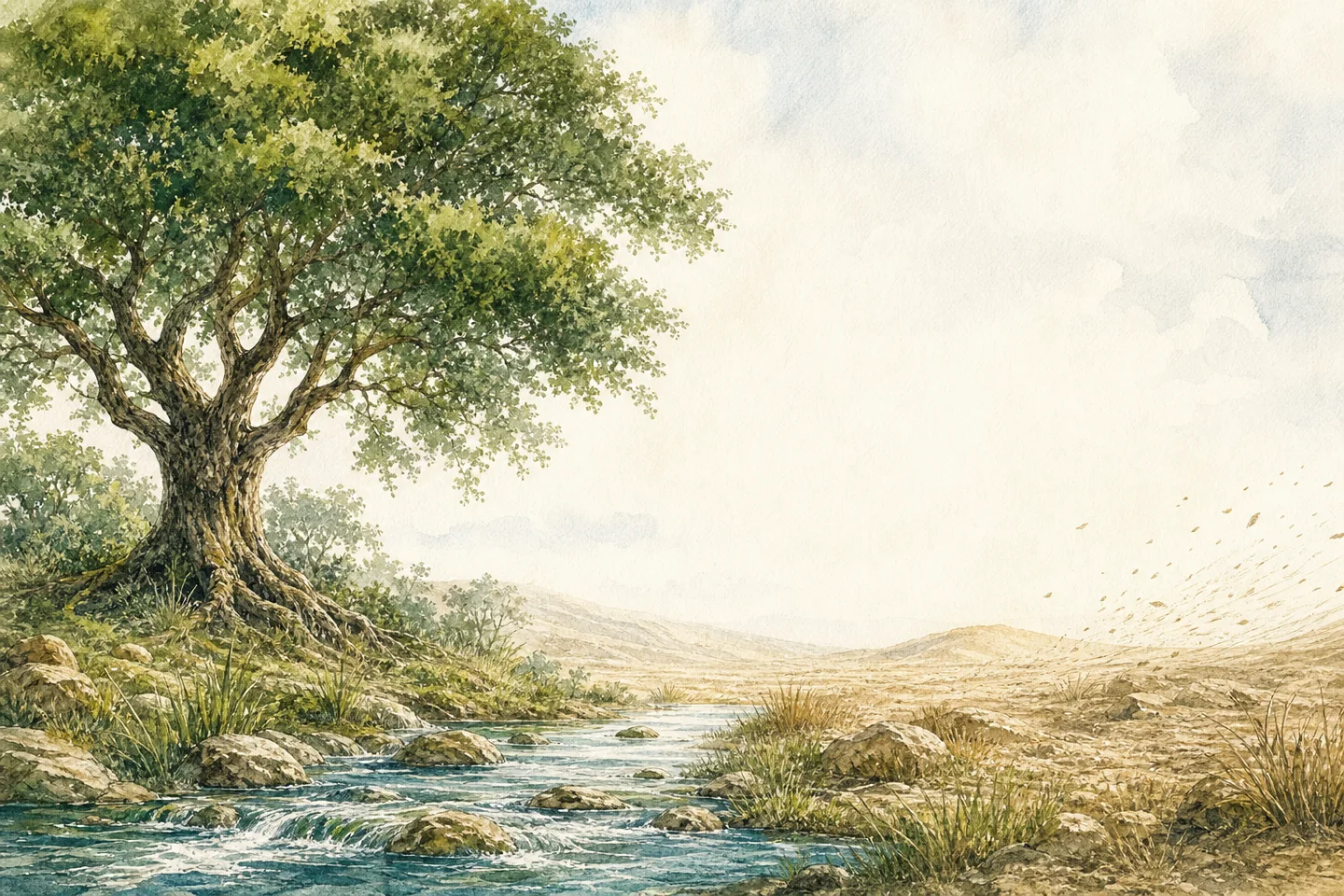
Psalm 1 presents two ways through ordinary choices: which counsel is heard, where a person remains, and what occupies attention. The tree and the chaff turn those choices into images of stability and dispersal.
Psalm 1 at a Glance: A Gateway to the Psalms
Psalm 1:1–6 is wisdom poetry. Rather than recounting an event, it describes a moral and spiritual pattern: the way of the righteous and the way of the wicked. The psalm’s structure is strikingly simple. Verses 1–3 portray the blessed person; verses 4–5 describe the wicked by contrast; verse 6 states the decisive difference between their paths.
The opening word, “Blessed,” points to a life that is deeply well-ordered before God. That life is not defined by self-sufficiency. It is shaped by what a person refuses and, even more importantly, by what a person loves. The righteous person rejects counsel that leads away from God and takes delight in the Lord’s law or instruction.
Psalm 1 therefore gives readers a lens for approaching the Psalms as a whole. It sets worship, prayer, suffering, praise, and trust within the larger question of the way one walks. Proverbs uses a similar wisdom pattern when it contrasts the path of the righteous with the path of the wicked (Proverbs 4:14–19). Psalm 1 is not offering a shortcut to success; it is calling its readers to consider the source, direction, and end of a life.
Psalm 1:1–6 · Proverbs 4:14–19
Not Walking, Standing, or Sitting: How Influence Works in Verse 1
Psalm 1 begins by describing the person who does not “walk in the counsel of the wicked, nor stand on the path of sinners, nor sit in the seat of scoffers” (Psalm 1:1, WEB). The three expressions should not be treated as rigid psychological stages, but their order may suggest a literary intensification.
“Counsel” concerns the advice, assumptions, and vision of life that someone receives. A “path” is a settled course of conduct. A “seat” can suggest belonging, settled association, or an entrenched posture—here, the posture of scoffing. The movement is from listening to an ungodly perspective, to joining an ungodly practice, to becoming at home in a community of contempt.
This does not command isolation from people who do not share one’s faith. Scripture regularly calls for truthfulness, love, and witness among others. Psalm 1 addresses something more specific: allowing wickedness to become one’s moral formation. Proverbs similarly warns against being drawn in by sinful invitation and urges readers not to enter the path of the wicked (Proverbs 1:10–19; 4:14–19).
The verse invites honest examination. Which voices repeatedly shape our desires? Which habits make a destructive path seem normal? And where might cynicism be turning into a settled way of seeing God, other people, or goodness itself?
Psalm 1:1 · Proverbs 1:10–19 · Proverbs 4:14–19
The Psalm’s Positive Center: Delighting in the Lord’s Instruction
The righteous person is not simply someone who avoids harmful influences. Psalm 1:2 gives the positive center of the psalm: “his delight is in the LORD’s law. On his law he meditates day and night” (WEB). The term translated “law” can also convey the sense of the Lord’s instruction or teaching. The focus is God’s revealed guidance for life.
Delight matters. The psalm does not portray Scripture as a tool for earning favor or mastering a technique. It describes a heart increasingly drawn to what God teaches. Meditation, in this setting, is sustained, repeated attention to that instruction so that it shapes thought, speech, and action. “Day and night” communicates constancy and pervasiveness, not a demand for literal, uninterrupted reading.
Other passages clarify this connection between God’s word and everyday obedience. Deuteronomy 6:6–9 places God’s words on the heart and in the ordinary rhythms of home, travel, rest, and work. Joshua 1:7–8 joins meditation with careful obedience. Psalm 19:7–11 celebrates the Lord’s instruction as reliable, wise, right, and life-giving.
A practical response may be simple: read a portion of Scripture carefully, return to it during the day, pray its truth, and ask how it should reshape a decision or habit. Meditation is not escaping life; it is receiving God’s instruction as guidance within life.
Psalm 1:2 · Deuteronomy 6:6–9 · Joshua 1:7–8 · Psalm 19:7–11
The Tree by Streams of Water: Fruit, Stability, and True Prosperity
Psalm 1:3 gives the psalm’s best-known image: “He will be like a tree planted by the streams of water, that produces its fruit in its season, whose leaf also does not wither” (WEB). The tree is not surviving by accident. It is planted beside a dependable source of water. Its fruit comes “in its season,” and its leaf does not wither.
The image communicates provision, stability, and fruitfulness. A life rooted in the Lord’s instruction has a source beyond changing circumstances. Yet the psalm’s language should not be turned into a guarantee that every faithful person will receive wealth, uninterrupted health, or immediate visible success. The tree still bears fruit in its season; the psalm itself does not define prosperity as material ease.
When verse 3 says, “Whatever he does shall prosper,” it belongs within the tree metaphor and the psalm’s contrast of two ways. It describes the enduring fruitfulness and firmness of a life oriented toward God. Its deepest concern is not whether every project produces the desired outcome now, but whether a person’s way is truly nourished and brought toward God’s good end.
Jeremiah 17:5–8 offers a related picture of one who trusts in the Lord as a tree by water, while Psalm 92:12–15 uses flourishing and fruitfulness to describe the righteous. These passages illuminate Psalm 1 without removing its own emphasis: rootedness in the Lord’s instruction produces a life with lasting spiritual weight.
Psalm 1:3 · Jeremiah 17:5–8 · Psalm 92:12–15 · Galatians 6:7–8
Chaff, Judgment, and the End of the Wicked Way
Verse 4 introduces the sharp reversal: “The wicked are not so, but are like the chaff which the wind drives away” (Psalm 1:4, WEB). Chaff is the light husk separated from grain. In contrast to a living, planted tree, it has no root, no enduring substance, and no stable place when the wind comes.
The image is not mainly about emotional weakness. It describes a way of life that lacks permanence before God. Psalm 1:5 then places the contrast in the setting of judgment: the wicked will not stand in the judgment, nor sinners in the assembly of the righteous. The psalm sees human life within a final and communal horizon. A path that appears secure for a time is not therefore secure before God.
The final verse explains why the two ways cannot have the same outcome: “For the LORD knows the way of the righteous, but the way of the wicked shall perish” (Psalm 1:6, WEB). Here, the Lord’s knowing is more than bare awareness. In the psalm’s contrast, it expresses his recognition and sovereign care for the righteous way. It does not mean that God is cognitively unaware of the wicked; rather, their way ends in ruin.
Psalm 37:18–20 similarly connects the Lord’s attention to the blameless with the contrasting end of the wicked. Jesus’ teaching about the way that leads to life and the way that leads to destruction also echoes Psalm 1’s two-way pattern, while speaking in its own setting (Matthew 7:13–14).
Psalm 1:4–6 · Psalm 37:18–20 · Matthew 7:13–14
Reading the Two Ways Today Without Oversimplifying Life
Psalm 1 calls for perseverance, not simplistic judgments. It does not authorize readers to pronounce quickly on another person’s final standing before God. Nor does it say that present comfort proves righteousness or present hardship proves failure. Its concern is the direction of a life: what forms it, where it is rooted, and the fruit it bears over time.
The psalm can guide a few concrete questions. What counsel is shaping my imagination and decisions? What patterns am I beginning to treat as normal? Do I make room to delight in and reflect on God’s instruction? What kind of fruit is growing—not merely in achievement, but in faithfulness, wisdom, love, and endurance?
For Christian readers, later Scripture develops the theme of fruitfulness through abiding in Christ (John 15:1–8). That is a canonical development, not a replacement for Psalm 1’s original message. Likewise, Jesus’ picture of a house that stands through the storm emphasizes hearing and doing his words (Matthew 7:24–27). Both connections reinforce Psalm 1’s central concern: a durable life is formed by receptive, obedient dependence on God.
Read Psalm 1 slowly. Notice the counsel you receive, the path you are walking, and the source from which you hope to draw life. The psalm’s invitation is to become like a tree—not self-made or untouched by difficulty, but planted where God supplies what is needed to bear fruit in season.
Psalm 1:1–6 · John 15:1–8 · Matthew 7:24–27
Conclusion
The psalm closes with a quiet question of belonging. The tree remains beside its source and the chaff has no root; between those images, the reader is invited to identify which word truly feeds the chosen path.
Biblical references
- Psalms 1:1–6
- Proverbs 4:14–19
- Deuteronomy 6:6–9
- Joshua 1:7–8
- Psalms 19:7–11
- Jeremiah 17:5–8
- Matthew 7:24–27
- John 15:1–8