
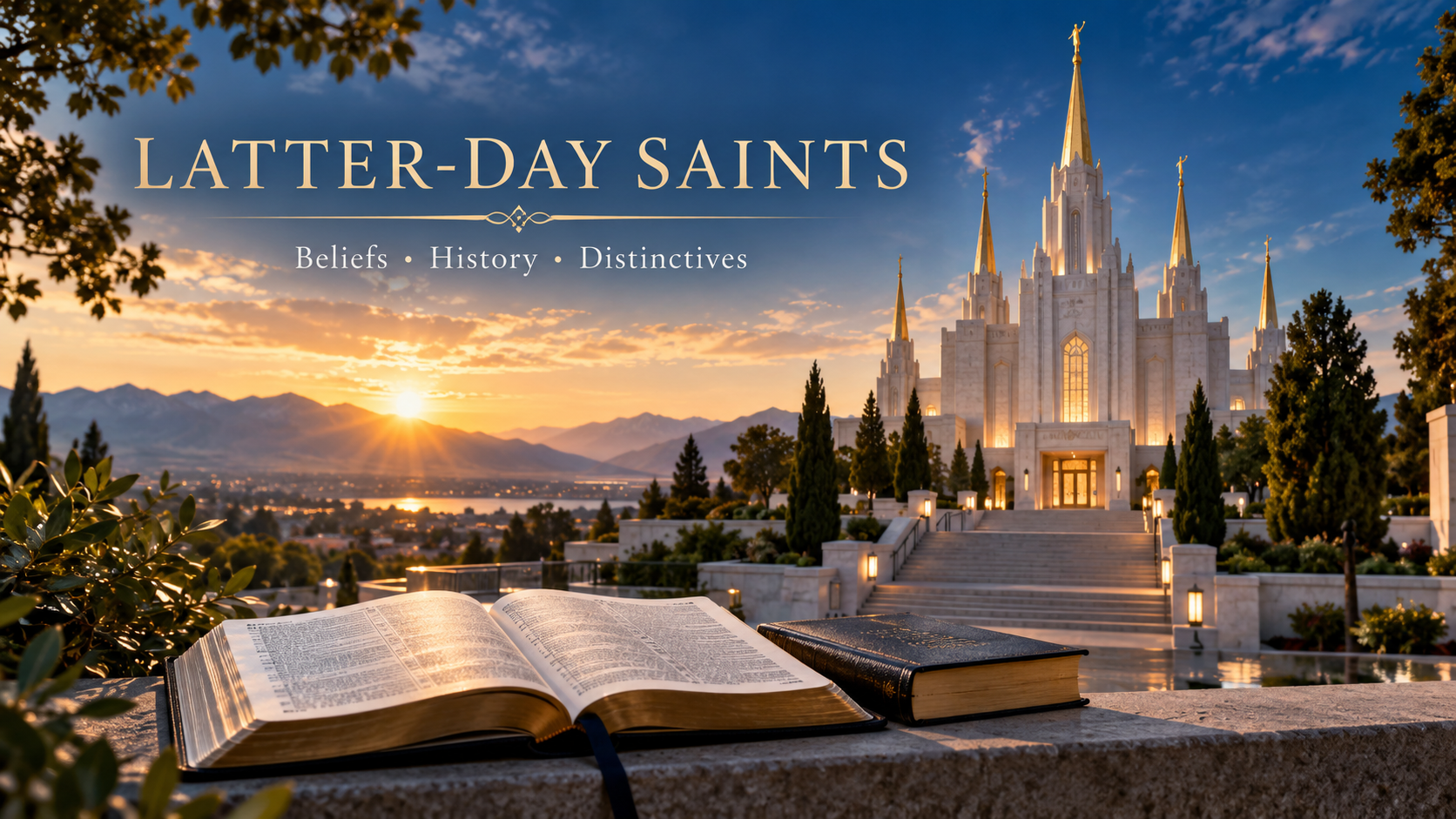
The Church of Jesus Christ of Latter-day Saints understands itself as a restoration of the Christianity taught by Jesus Christ and of the apostolic Church. Its members are commonly called Latter-day Saints. The word “Mormons” has been widely used historically, but the Church prefers its full name or “Latter-day Saints.”
Brief origin and history
The Church was organized in the United States in 1830 by Joseph Smith and his early followers. Its own view of history centers on a Restoration: after the apostolic age, the fulness of the gospel and priesthood authority were no longer present on earth and were restored by God through modern revelation.
For this reason, the movement does not understand itself simply as another Protestant denomination, but as a restoration of Christ’s Church.
Scriptures
Latter-day Saints regard the Bible as the word of God and study it regularly. Their canon also includes the Book of Mormon, Doctrine and Covenants, and Pearl of Great Price. Together with the Bible, these are called the standard works.
They also believe in continuing revelation and in living prophets and apostles.
God and the Godhead
The Church teaches belief in Heavenly Father, Jesus Christ, and the Holy Ghost. Together they form the Godhead.
This differs from the classical Trinitarian formulation of Catholicism, Orthodoxy, and most Protestant churches. Latter-day Saints understand the Father, Son, and Holy Ghost as three distinct beings perfectly united in purpose and doctrine. The Church also teaches that the Father and the Son have glorified bodies, while the Holy Ghost is a personage of spirit.
Jesus Christ
Jesus Christ stands at the center of Latter-day Saint faith. The Church confesses him as Son of God, Savior, and Redeemer. His Atonement, death, and Resurrection make forgiveness, resurrection, and return to God’s presence possible.
The Book of Mormon presents itself as “another testament of Jesus Christ,” intended to witness of him together with the Bible.
Salvation and exaltation
In this theology, salvation can be used in several senses. Through Christ’s Resurrection all human beings will be resurrected. Salvation from sin is also connected with the grace of Jesus Christ, repentance, and a life of discipleship.
Exaltation refers to the fulness of eternal life with God in the highest degree of celestial glory. Covenants and certain ordinances have an important place on that path.
Religious authority
The Church teaches that priesthood authority was restored by God. It is presided over by a president regarded as prophet, seer, and revelator, accompanied by apostles and other leaders. Modern revelation therefore has an important place alongside scripture.
Baptism and ordinances
Baptism is by immersion and, according to Church teaching, must be performed by one holding priesthood authority. Confirmation and reception of the gift of the Holy Ghost follow.
Other ordinances are performed in temples, including the endowment, marriage sealing, and proxy baptism for deceased persons. The Church teaches that the dead remain free to accept or reject ordinances performed on their behalf.
Temples and family
Temples are sacred spaces reserved for covenants and ordinances. Family has distinctive doctrinal importance, and a temple sealing can be understood as a marriage intended to continue beyond death when its covenants are kept.
The Lord’s Supper
At Sunday meetings members participate in the sacrament, a memorial of Jesus Christ in which bread and water are distributed and baptismal commitments are symbolically renewed.
The afterlife
Church teaching describes premortal existence, mortal life, death, the spirit world, resurrection, and judgment. After judgment, different degrees or “kingdoms” of glory are taught. Exaltation refers to the highest degree of the celestial kingdom.
Distinctive practices
Well-known features include study of the Bible and Book of Mormon, missionary service, temples, proxy ordinances, strong emphasis on family, and leadership by contemporary prophets and apostles.
What to keep in mind when comparing
Latter-day Saints share with other Christian churches a strong focus on Jesus Christ, use of the Bible, baptism, and hope in resurrection. At the same time, they differ from historic Christian formulations regarding the nature of God, additional scripture, continuing revelation, the Restoration, priesthood authority, and temple ordinances.